Le Beau Serge

Le Beau Serge

Movie · 1958 · 9 people

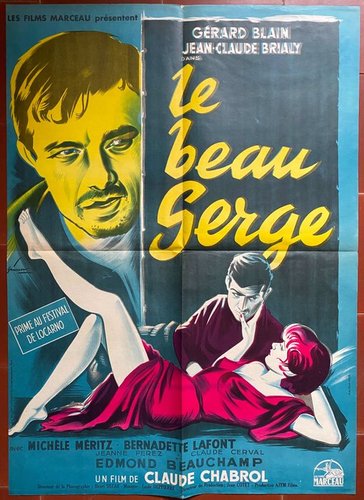
Often named as the first product of the French New Wave, and counted by some specialists among the movement's key forerunners, Le Beau Serge (literally "Handsome Serge") was Claude Chabrol's first feature. He wrote and directed this French drama in 1958. In German-speaking countries it was released as Die Enttäuschten, and in Spanish it carries the title El bello Sergio. It runs 99 minutes and was made in French. It is often compared with Chabrol's next film, Les Cousins, since both star Gérard Blain and Jean-Claude Brialy.

The story begins when a young man named François, recovered from an illness, returns to his home village after a long absence. There he finds his old friend Serge a disillusioned, hard-drinking man who has given up his former hopes. Trying to pull his friend out of this decline, François has to face the closed and tense world of provincial life.

Besides Gérard Blain and Jean-Claude Brialy, the cast includes Bernadette Lafont, Claude Cerval, Edmond Beauchamp, Harry-Max, Jacques Doniol-Valcroze, Jean Gruault and Jeanne Pérez, along with the director himself. The film won the best director prize at the Locarno Film Festival and the Jean Vigo Prize.

DirectorClaude Chabrol
Le Beau Serge

Reactions

You can pick up to 3 reactions.

Cast

Only cast members with a profile on this site are listed.

Through different eyes

Cinephile Looks at script, editing and directing choices; keeps a distance from formula films.

Chabrol's first feature makes it easy to see why it is cited as the first product of the French New Wave: instead of big events, it leans on the tension between two old friends and the stifling air of the provinces. The script does not leave François's rescuer stance unquestioned; that ambiguity, hinting that good intentions can shade into arrogance, is the film's greatest strength. The contrast between Gérard Blain and Jean-Claude Brialy carries the whole structure. Its weak spot is a pace that sometimes drags and shows the marks of a debut. The best director prize at Locarno feels like a fitting reward for the confidence of this first step. Watched back to back with Les Cousins, the two films shed light on each other.

History & Society Lens Asks about the period, the social background and what the work reflects.

The French provinces of the late fifties appear here not as a postcard but as a closed community that watches itself and resists change. The gap between François, who returns to his village after recovering from an illness, and Serge, who has given up his hopes and turned to drink, also speaks of the distance between town and country, between those who leave and those who stay. Rather than judging provincial life, the film shows how being stuck there wears a person down. For anyone who wants to see youth swinging between hope and disillusion from inside its own time, it is a valuable testimony.

Action & Thriller Fan Puts pace, tension and set pieces first; little patience for slow drama.

Let's be honest: this one is not for people who want pace. For 99 minutes everything moves through the tension between two friends, through looks and long silences. Still, there is a raw nerve in the way Serge burns himself out, a feeling that something could snap at any moment. Give it patience and it stays with you, but if slow drama tests you, you may struggle.

These are not reader reviews: they are short editorial takes written from different viewer perspectives with AI assistance. Reader reviews are below.

Reviews (0)

Log in Log in to write a review.

Comments