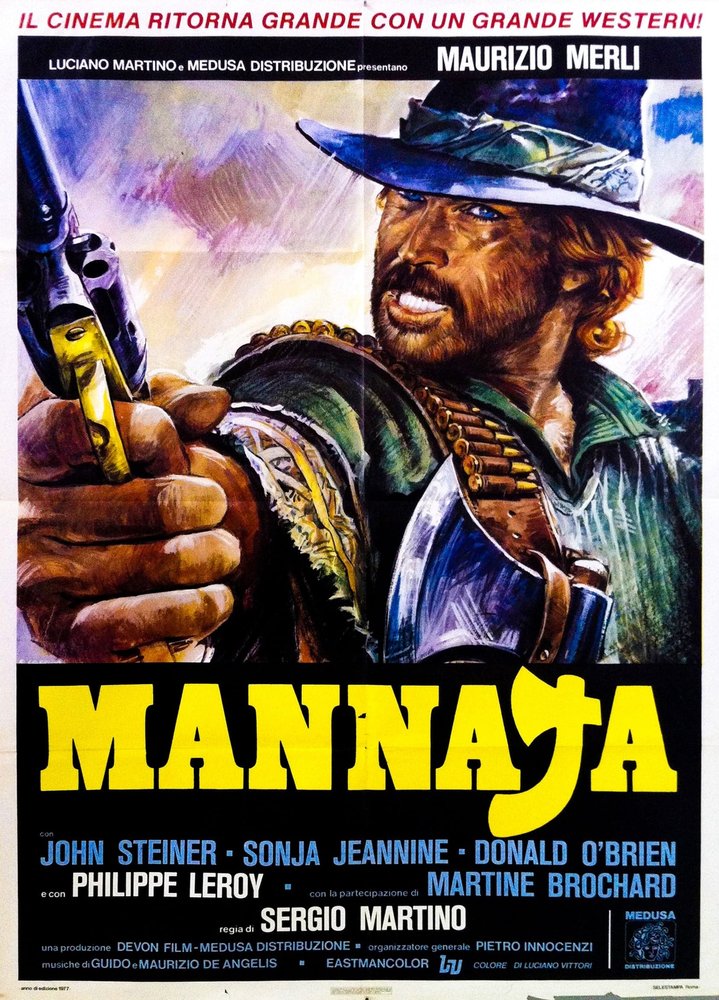
Mannaja

Mannaja

Movie · 1977 · 15 people

Mannaja is a 1977 Italian spaghetti Western directed by Sergio Martino, who also wrote the screenplay with Sauro Scavolini. Its title is the Italian word for a hatchet, and internationally the film also circulated as A Man Called Blade. In Germany it was shown as Mannaja – Das Beil des Todes and Der letzte der Bounty Killer, in France as Mannaja, l'homme à la hache, in Spain as El valle de la muerte and in Brazil as Vingança Cega. The film, in Italian, runs about 101 minutes.

Maurizio Merli plays the lead role of Blade. The other central roles go to John Steiner, Sonja Jeannine, Donald O'Brien, Philippe Leroy and Martine Brochard, and the cast also includes Antonio Casale, Enzo Fiermonte, Rik Battaglia, Aldo Rendine, Enzo Maggio, Bruno Di Luia and Nello Pazzafini.

It is one of the genre's late entries and is counted, together with Enzo Castellari's Keoma, among the last important spaghetti Westerns. The score is by the brothers Guido and Maurizio De Angelis, and the soundtrack swings unpredictably between Italian Western ballads, contemporary pop, synth-driven suspense themes and 1970s progressive rock. Mannaja earned about 750 million lire at the Italian box office, roughly half a million US dollars. It was released on DVD by Blue Underground.

DirectorSergio Martino

Reactions

You can pick up to 3 reactions.

Cast

Only cast members with a profile on this site are listed.

Nello Pazzafini Nello Pazzafini Actor · died at 62 Alberto Dell'Acqua Alberto Dell'Acqua Actor · born 1938 Maurizio Merli John Steiner Donald O'Brien Philippe Leroy Martine Brochard Antonio Casale Enzo Fiermonte Rik Battaglia Aldo Rendine Enzo Maggio Sophia Lombardo Sonja Jeannine Salvatore Puntillo
Through different eyes

Action & Thriller Fan Puts pace, tension and set pieces first; little patience for slow drama.

Even the name tells you what's coming: it means axe. Mannaja is counted, alongside Keoma, among the last important spaghetti westerns, so if you want an example of the genre's late period, this is the place to go. The music swinging from western ballad to progressive rock keeps the energy up. But the story and its formulas may not hold many surprises for anyone who knows the genre; expect a solid farewell to the form rather than anything new.

Cinephile Looks at script, editing and directing choices; keeps a distance from formula films.

Sergio Martino's film tries to keep the rules of the spaghetti western in its late period while giving them a new surface. The most striking element is the De Angelis brothers' score, which swings unpredictably between western ballads, contemporary pop, synth-heavy suspense themes and progressive rock. That restlessness gives the film an identity of its own but also strains its tonal unity; some of the shifts look less like a deliberate style than a surrender to the fashions of the day. Its standing, with Keoma, among the genre's last important entries explains its historical value. A late-period piece worth studying for anyone curious about how the genre changed.

History & Society Lens Asks about the period, the social background and what the work reflects.

Mannaja can also be read as a document from the last days of a genre. The assessments that place it, with Keoma, among the last important spaghetti westerns suggest a film made in a spirit of farewell. The score's drift from western ballad to contemporary pop and progressive rock shows how the popular culture of the time was seeping into an older form. And its Italian takings, close to half a million dollars at the exchange rates of the day, suggest a genre now speaking to a loyal following rather than a mass audience.

These are not reader reviews: they are short editorial takes written from different viewer perspectives with AI assistance. Reader reviews are below.

Reviews (0)

Log in Log in to write a review.

Comments