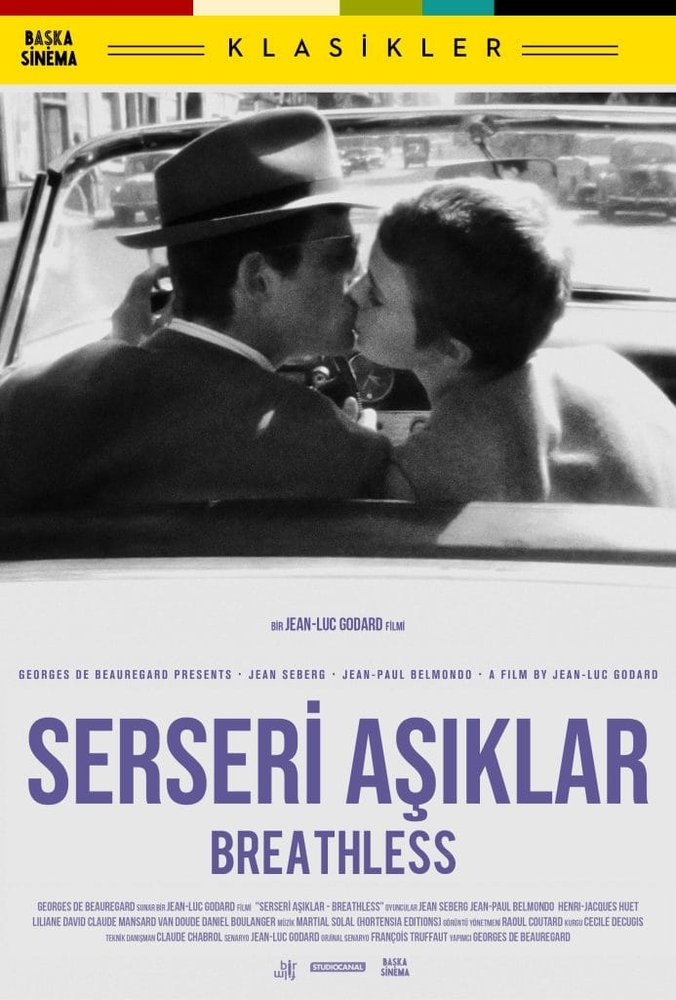
Serseri Aşıklar

Breathless (À bout de souffle)

Movie · 1960 · 15 people

Breathless (À bout de souffle) is Jean-Luc Godard's first feature, a black-and-white French crime drama from 1960 and one of the defining works of the French New Wave. It premiered on March 16, 1960. It drew attention for its bold visual style and the then unconventional use of jump cuts.

Jean-Paul Belmondo plays Michel Poiccard, a wandering criminal who steals a car in Marseille and kills a policeman on the road, a breakthrough role. Michel turns up in Paris and looks up Patricia (Jean Seberg), a young American working for the New York Herald Tribune; hunted by the police, he tries to raise money for Rome and take her along, though she is unsure of her feelings. Jean-Pierre Melville also appears.

The story rests on an idea by François Truffaut drawn from a newspaper report about the killing of a policeman, which Godard rewrote. Shooting lasted under four weeks without a finished script: Godard wrote the scenes in the morning and handed the actors their lines only as they were filmed. Raoul Coutard was the cinematographer. The film drew over two million viewers in France, won the Silver Bear for Best Director at the Berlin Film Festival and the Prix Jean Vigo, and has been ranked among the best films ever made.

DirectorJean-Luc Godard

Reactions

You can pick up to 3 reactions.

Cast

Only cast members with a profile on this site are listed.

Jean-Paul Belmondo Jean-Paul Belmondo Film actor · died at 88 Jean-Pierre Melville Jean-Pierre Melville Actor · died at 55 Jean Seberg Daniel Boulanger André S. Labarthe Claude Mansard François Moreuil Henri-Jacques Huet Jacques Siclier Jean Domarchi Jean Douchet Jean-Louis Richard José Bénazéraf Liliane David Richard Balducci
Through different eyes

Cinephile Looks at script, editing and directing choices; keeps a distance from formula films.

Judging Breathless on its story alone misses the point; the real subject is form. The jump cuts, unusual at the time, combine with a method of writing scenes in the morning and handing out lines during the take to produce editing that defies the rules. Because those cuts are now everywhere, from music videos to adverts, it is hard to recapture how startling they first were, and some viewers may read the improvised air as sloppiness. But a debut that changes the language of film this much is rare. For anyone trying to understand the New Wave, it is still one of the best places to start.

History & Society Lens Asks about the period, the social background and what the work reflects.

By pairing a French drifter with a young American working for the New York Herald Tribune in 1960 Paris, the film also registers the weight of American culture in post-war Europe. Michel's refusal to settle into any ordinary life and Patricia's indecision can be read as a portrait of a generation looking for its own way. Drawing over two million viewers in France shows that this restless picture of youth reached a broad audience, not just critics. Seen from today, the way it makes a fugitive who has killed a policeman so attractive is worth debating in its own right.

Action & Thriller Fan Puts pace, tension and set pieces first; little patience for slow drama.

On paper the plot is a straight crime thriller: a stolen car, a dead policeman, a manhunt. But anyone going in expecting that may be disappointed; the film cares more about its characters' attitude than about the chase. Its pace comes from choppy, jumping edits, not from action scenes. If you want a classic cop thriller, pick something else; if you are curious about how cinema changed, give it a go.

These are not reader reviews: they are short editorial takes written from different viewer perspectives with AI assistance. Reader reviews are below.

Reviews (0)

Log in Log in to write a review.

Comments