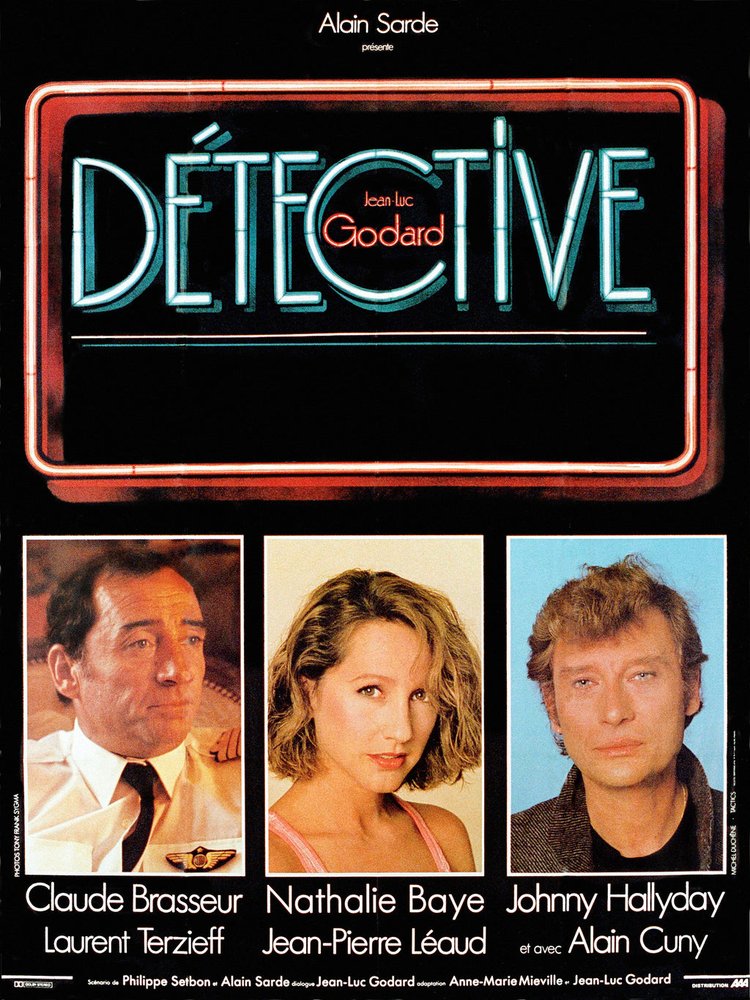
Détective

Detective

Movie · 1985 · 12 people

Jean-Luc Godard wrote and directed Détective, a crime drama from 1985. Some sources describe it as a French-Swiss co-production. It was shown in the main competition at the 1985 Cannes Film Festival. That year it also took the Georges Delerue Award at Film Fest Gent, given for the best use of existing music, and the prize for the most innovative film at the Rotterdam festival. It opened in France on 10 May 1985 and in the United States on 23 August.

The action takes place in a large Paris hotel. The stories of a couple heading for a split, two debts, a boxing match in preparation and two detectives investigating a two-year-old murder first pile up, then collide. Nathalie Baye, Jean-Pierre Léaud, Laurent Terzieff, Johnny Hallyday, Claude Brasseur and Alain Cuny lead the cast, with Emmanuelle Seigner and Julie Delpy also appearing.

Godard fills the crime frame with references from literature, film and music: characters borrowed from Shakespeare's The Tempest, Joseph Conrad's Lord Jim, René Char and André Breton, Cocteau's La Belle et la Bête, and Schubert, Wagner, Chopin, Liszt and Chabrier. The film stubbornly refuses to resolve its story, yet it is regarded as the director's last "conventional" film. It runs 95 minutes.

DirectorJean-Luc Godard

Reactions

You can pick up to 3 reactions.

Cast

Only cast members with a profile on this site are listed.

Nathalie Baye Nathalie Baye Actor · died at 77 Jean-Pierre Léaud Jean-Pierre Léaud Film actor · 82 years old Laurent Terzieff Johnny Hallyday Claude Brasseur Alain Cuny Emmanuelle Seigner Julie Delpy Stéphane Ferrara Alexandra Garijo Xavier Saint-Macary Ann-Gisel Glass
Through different eyes

Cinephile Looks at script, editing and directing choices; keeps a distance from formula films.

Détective uses the crime-film template as a skeleton and piles literary, musical and cinematic quotations on top of it, layer by layer. Stories crossing in a single hotel set up the expectation of a classic narrative, and Godard deliberately frustrates it; the unresolved plot isn't a flaw but the film's stance. Its award for the use of existing music is no accident: the pieces, from Schubert to Wagner, work like a second voice commenting on the scenes. Still, the density of references can be less a game than a wall for anyone unfamiliar with Godard's idiom. The most rewarding way in, I think, is to treat it as his last conventional film, a record of a transition in his career.

Action & Thriller Fan Puts pace, tension and set pieces first; little patience for slow drama.

A hotel, an old murder investigation, a boxing match in the works, debts... on paper it's a full-on crime movie. But nobody here intends to build tension out of any of it. The storylines crash into each other and are then left hanging. If you put it on expecting a detective film, you'll most likely be disappointed. For those who can leave genre expectations at the door it's an interesting experiment, and that's about it.

History & Society Lens Asks about the period, the social background and what the work reflects.

Setting the film in a large Paris hotel turns it into a small-scale model of society: a couple on the verge of splitting, people chasing debts, a boxer preparing for a fight and detectives digging into an old murder all share the same corridors. It's telling that the main thread tying these characters together is money and debt. Godard's references, from Shakespeare to Conrad, put high culture and ordinary crime in the same frame. For anyone curious how mid-1980s art cinema wrestled with popular genres, it's an instructive example.

These are not reader reviews: they are short editorial takes written from different viewer perspectives with AI assistance. Reader reviews are below.

Reviews (0)

Log in Log in to write a review.

Comments