Kadın Kadındır

A Woman Is a Woman (Une femme est une femme)

Movie · 1961 · 5 people

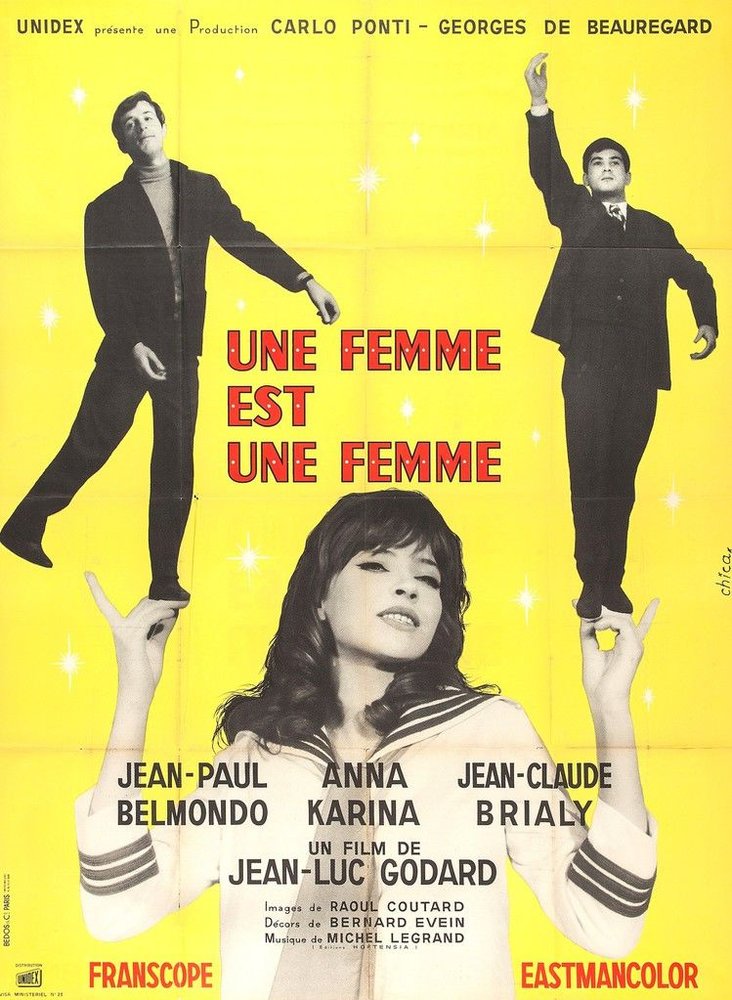
Romantic musical comedy was the form of Une femme est une femme (A Woman Is a Woman), a French-Italian production from 1961. French New Wave pioneer Jean-Luc Godard wrote and directed it. He called it a "New Realist musical"; it is a witty tribute to American musical comedies. It was his first film in colour and in widescreen, and it opened in France on 6 September 1961.

The story unfolds in Paris. Angela, a striptease dancer, wants nothing more than a baby, but the man she lives with, Émile, is reluctant and keeps putting it off. Anna Karina plays Angela and Jean-Claude Brialy plays Émile. Pressed, Émile half-jokingly suggests that she spend a night with his best friend Alfred, played by Jean-Paul Belmondo. When Alfred then confesses his love for her, the joke turns serious,and misunderstandings, jealousy and quarrels follow. Jeanne Moreau makes a brief guest appearance.

It was Godard's third feature but reached cinemas second, as Le petit soldat was held back by censors. Georges de Beauregard and Carlo Ponti produced, and Michel Legrand wrote the score. It was shot entirely in Paris in Franscope. Though a commercial failure on release, it was a Golden Bear nominee at the Berlin Film Festival, where Anna Karina won Best Actress and Godard took a special Silver Bear.

DirectorJean-Luc Godard

Reactions

You can pick up to 3 reactions.

Cast

Only cast members with a profile on this site are listed.

Through different eyes

Cinephile Looks at script, editing and directing choices; keeps a distance from formula films.

Godard's first encounter with colour and widescreen is an experiment that winks at American musicals with both admiration and mischief. He called it a 'New Realist musical': it takes the genre's rules and carries them into the everyday texture of Paris. Michel Legrand's score is the backbone of the game, sometimes lifting the emotion into song, sometimes cutting off abruptly to remind us we are watching a film. Anna Karina, in the performance that won her the Berlin acting prize, makes Angela both childlike and stubborn, while Belmondo and Brialy give the triangle a light comic rhythm. Its commercial failure on release is no surprise, since the film keeps leaving viewers who expect classical storytelling stranded halfway. But for anyone who wants to see the New Wave's nerve in playing with form, it still feels remarkably fresh.

Yeşilçam Nostalgic A viewer raised on the classics, looking for warm storytelling and strong acting.

Michel Legrand's music and Anna Karina's radiant face do a heart good if it misses the colourful magic of old cinema. The story itself is familiar from our own melodramas: a woman who wants a child, a man who keeps putting it off, and a friend who comes between them. But Godard tells it with playfulness rather than tears; just as the emotion is about to swell, a joke cuts in. For someone used to Yeşilçam's heartfelt, wholehearted storytelling, that distance can feel cold at times. Even so, this colourful Parisian fable is worth seeing at least once.

Family Viewer Asks whether the whole household can watch it; cares about humour and heart.

Don't mistake this for a children's film just because it is colourful and full of music. Angela is a striptease dancer, and the story revolves around a couple's quarrels over having a baby and plenty of jealousy. Things like her partner's joke about her spending a night with his best friend are not for young kids. Adults, especially fans of older French films, may enjoy it. But its playful, unusual style makes it a hard choice for a whole-family movie night.

These are not reader reviews: they are short editorial takes written from different viewer perspectives with AI assistance. Reader reviews are below.

Reviews (0)

Log in Log in to write a review.

Comments