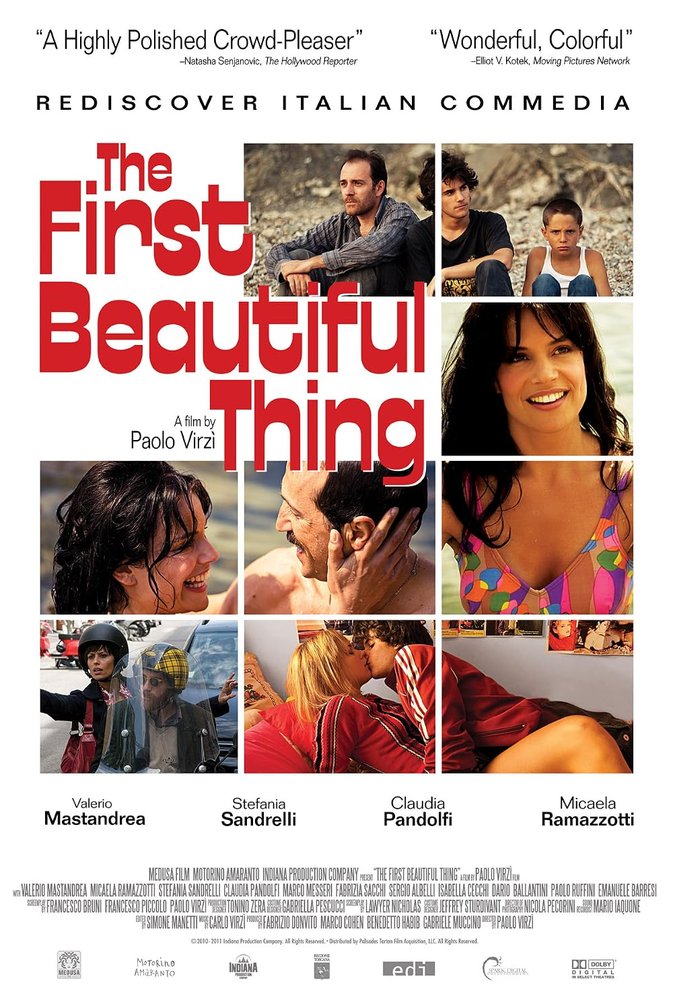
The First Beautiful Thing

The First Beautiful Thing (La prima cosa bella)

Movie · 2010 · 15 people

Paolo Virzì directed The First Beautiful Thing (Italian title La prima cosa bella), a 2010 Italian comedy-drama. It reached Italian cinemas on 15 January 2010 and took its name from a Nicola Di Bari song that became popular in the 1970s. It was chosen as Italy's entry for the Best Foreign Language Film at the 2011 Academy Awards, though it was not nominated.

The story begins in the summer of 1971 at a beauty pageant held at a seaside resort in Livorno, where the young, lively Anna is called on stage and crowned "most beautiful mother". The event upsets the Michelucci household. When her husband mistreats her, Anna leaves home and starts a new life with her two small children, Bruno and Valeria. Her turbulent path marks the children, above all the elder, Bruno. Spanning some four decades, the narrative sets the family's fortunes beside Italy's own changes. The film stars Micaela Ramazzotti, Valerio Mastandrea, Claudia Pandolfi and Stefania Sandrelli.

It was produced by Medusa Film, Motorino Amaranto and Indiana Production, and filming began on 11 May 2009. At the 2010 David di Donatello awards it earned 18 nominations and won best screenplay, best actress (Micaela Ramazzotti) and best actor (Valerio Mastandrea). It also took four Silver Ribbons, including direction and cinematography.

DirectorPaolo Virzì
Production companyMedusa Film

Reactions

You can pick up to 3 reactions.

Cast

Only cast members with a profile on this site are listed.

Valerio Mastandrea Valerio Mastandrea Actor · 54 years old Stefania Sandrelli Stefania Sandrelli Actor · 80 years old Micaela Ramazzotti Claudia Pandolfi Marco Messeri Dario Ballantini Paolo Ruffini Isabelle Adriani Isabella Cecchi Sergio Albelli Fabrizia Sacchi Emanuele Barresi Roberto Rondelli Franco Sacchi Alessia Innocenti
Through different eyes

Cinephile Looks at script, editing and directing choices; keeps a distance from formula films.

Virzì's film tries to fit some four decades into the story of a single family, and the biggest test for this kind of structure is keeping emotional continuity across the time jumps. The best screenplay prize at the David di Donatello awards suggests that balance was struck. Weaving comedy into drama gives breathing room to a heavy story of motherhood and a family coming apart, but those shifts in tone may not sit equally well with every viewer, since carrying lightness and hurt in the same film is not easy. The two award-winning lead performances look like the film's backbone, and the Silver Ribbon for cinematography suggests the period atmosphere was built with care.

History & Society Lens Asks about the period, the social background and what the work reflects.

Opening the story at a beauty pageant in Livorno in the summer of 1971 is a telling choice: a woman being crowned "most beautiful mother" and thereby shaking up a household says a lot about the female body, family honour and a husband's authority in the Italy of that time. Anna leaving home with her two small children after her husband's mistreatment was not a decision to take lightly in those years. Setting the family's fortunes beside Italy's own changes turns a personal drama into a social timeline. Even so, such a wide period canvas runs the risk of leaving the historical background as mere scenery at times.

Family Viewer Asks whether the whole household can watch it; cares about humour and heart.

It may look like a warm story about the bond between a mother and her children, but at its centre are mistreatment at home and a family falling apart. There are comic touches, yet the subject is heavy. It is not one for small children. For teenagers and adults, though, it can be a good choice for an evening when you want to talk about motherhood and family.

These are not reader reviews: they are short editorial takes written from different viewer perspectives with AI assistance. Reader reviews are below.

Reviews (0)

Log in Log in to write a review.

Comments