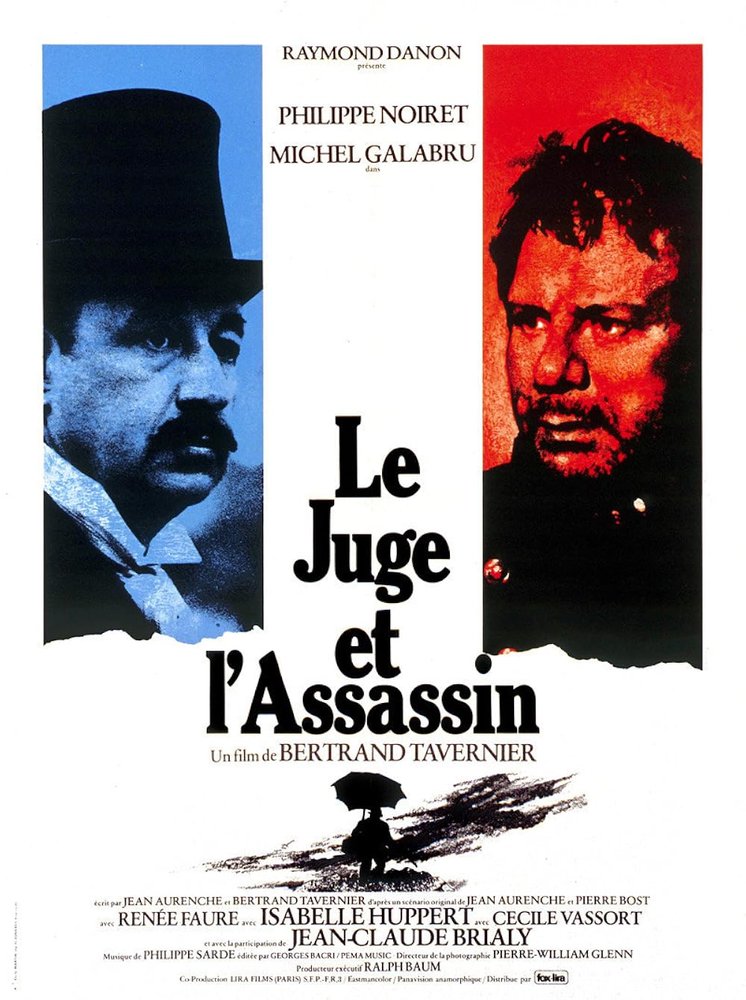
The Judge and the Assassin

The Judge and the Assassin (Le Juge et l'Assassin)

Movie · 1976 · 15 people

Bertrand Tavernier directed The Judge and the Assassin (original title Le Juge et l'Assassin) in 1976, a French film that moves between drama, crime and the historical courtroom picture; some sources also label it a comedy-drama. Based on real events, it draws on the story of Joseph Vacher, a serial killer remembered for numerous brutal crimes in late nineteenth-century France. The film won two César Awards in 1977.

The story is set in 1890s France. A former soldier of doubtful sanity, who has left a trail of rapes and murders, is finally caught. An ambitious judge handling the case grows close to the prisoner, earns his trust and steers him into speaking against himself. This double-edged relationship between friendship and calculation is the heart of the film. Philippe Noiret, Isabelle Huppert, Michel Galabru and Jean-Claude Brialy head the cast, which also includes Christine Pascal, Gérard Jugnot, Daniel Russo and Didier Haudepin.

Tavernier wrote the script with Jean Aurenche and Pierre Bost. The film runs about 128 minutes and was shot in French. It reached Germany as Der Richter und der Mörder and Spain as El juez y el asesino.

DirectorBertrand Tavernier

Reactions

You can pick up to 3 reactions.

Cast

Only cast members with a profile on this site are listed.

Michel Galabru Michel Galabru Film actor · died at 93 Jean-Claude Brialy Jean-Claude Brialy Stage actor · died at 74 Philippe Noiret Isabelle Huppert Antoine Baud Arlette Bonnard Aude Landry Cécile Vassort Christine Pascal Daniel Russo Didier Haudepin François Dyrek Gérard Jugnot Gilles Dyrek Jean Bretonnière
Through different eyes

History & Society Lens Asks about the period, the social background and what the work reflects.

The film is based on a real case, that of Joseph Vacher, remembered for numerous brutal crimes in late nineteenth-century France, but what really interests it is the system judging him as much as the criminal. An ambitious judge winning the defendant's trust and steering him into incriminating himself shows how justice can become entangled with personal career calculations. A powerful official facing a former soldier of doubtful sanity: that imbalance puts on the table the question of whom, and what, the criminal justice of the period served. As a historical courtroom film it touches on questions still debated today, such as where madness ends and responsibility begins.

Cinephile Looks at script, editing and directing choices; keeps a distance from formula films.

Tavernier's film resists genre labels: it moves between drama, crime and historical courtroom picture, and some sources even call it a comedy-drama. That slippery tone looks like a deliberate choice of the script he wrote with Jean Aurenche and Pierre Bost; the bond between judge and killer, where friendship and calculation intertwine, could only be this unsettling in a story that refuses to lock into one register. The audience is kept unsure whom to trust, and the film's moral weight comes precisely from that uncertainty. Two César Awards show the boldness paid off. My reservation is length: for a structure that puts the whole load on its central relationship, the film runs long and may try impatient viewers.

Family Viewer Asks whether the whole household can watch it; cares about humour and heart.

This is not a family film. Its subject is the capture and trial of a killer who left a trail of rapes and murders, and it is based on a real case. Do not plan it for children or younger teens. It suits adults interested in history and law who can handle a heavy subject. If you are looking for an easy film everyone can sit down to after dinner, this is not it.

These are not reader reviews: they are short editorial takes written from different viewer perspectives with AI assistance. Reader reviews are below.

Reviews (0)

Log in Log in to write a review.

Comments