Papy fait de la résistance

Papy fait de la résistance

Movie · 1983 · 4 people

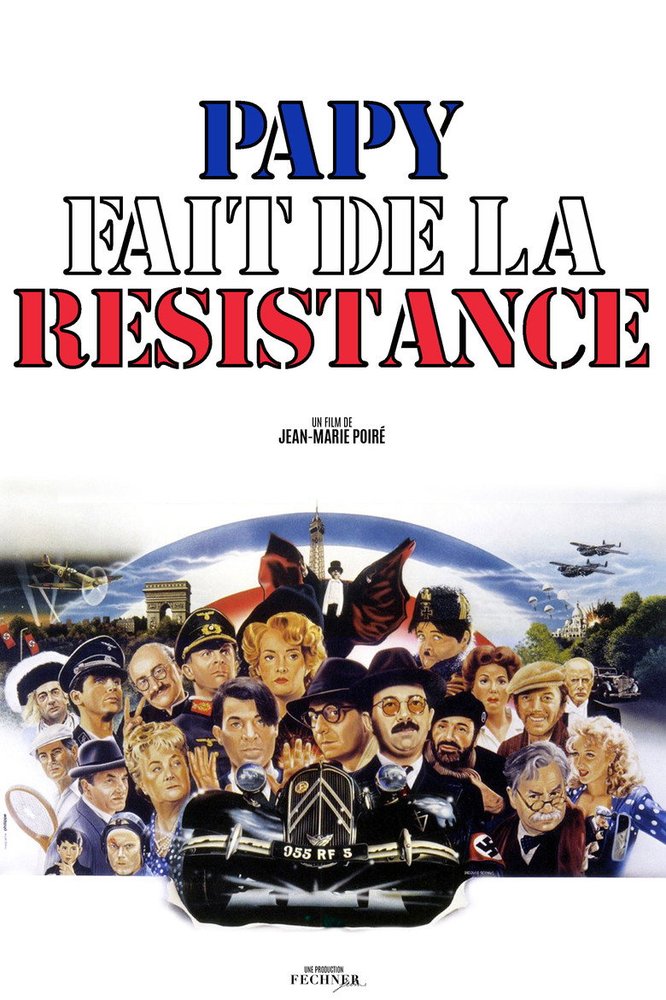
Jean-Marie Poiré's 1983 French war comedy Papy fait de la résistance, sold in English-speaking markets as Gramps Is in the Resistance, was savaged by French critics on release, yet it drew four million admissions and over the years became a cult film in France. Adapted from a stage play written and originally staged by the Le Splendid company, it spoofs Resistance and Second World War cinema, down to the crowded all-star line-ups of The Longest Day and Is Paris Burning?.

The story sets resistance fighters against collaborators in occupied France. Two generations share the cast: the "new generation" of the 1970s and 80s, namely the Le Splendid troupe plus Jacques Villeret, Roland Giraud and Pauline Lafont; and the previous generation, Michel Galabru, Jacqueline Maillan and Jean Carmet. Christian Clavier, Gérard Jugnot, Martin Lamotte, Dominique Lavanant and Bernard Giraudeau are also in the cast.

The film is dedicated to the memory of Louis de Funès, who was to play Papy or Hitler's half-brother but died as the project began; Papy went to Michel Galabru and the half-brother to Jacques Villeret. Clavier, Lamotte and Poiré wrote the script, Les Films Christian Fechner produced it, and it runs 102 minutes.

DirectorJean-Marie Poiré
Production companyLes Films Christian Fechner

Reactions

You can pick up to 3 reactions.

Cast

Only cast members with a profile on this site are listed.

Through different eyes

Cinephile Looks at script, editing and directing choices; keeps a distance from formula films.

As a parody, Papy fait de la résistance takes aim at the star-packed ensemble tradition of Second World War films; the nod to The Longest Day is no accident. The Le Splendid troupe's stage roots show in the writing: gags arrive one after another in sketch fashion, which sometimes keeps the rhythm lively and sometimes leaves the story in pieces. The script by Clavier, Lamotte and Poiré plays for speed rather than finesse. The savage reception from French critics on release is understandable, yet four million admissions and the cult status it earned over the years show that this unruly energy has a language of its own. Casting two generations side by side is the film's smartest move.

History & Society Lens Asks about the period, the social background and what the work reflects.

Resistance fighters and collaborators in occupied France are among the most sensitive subjects in French memory. This film's nerve lies in freeing that period from the solemnity of heroic narratives and turning it into material for comedy. Its target is less the war itself than the stock language of films about the war. That such a parody reached a mass audience in the early 1980s can be read as a sign of the distance between the generation that lived through the war and those who came after, and the meeting of generations in the cast fits that reading. Still, laughing at something as heavy as collaboration will not sit well with everyone, and some local references may be lost on a Turkish audience.

Yeşilçam Nostalgic A viewer raised on the classics, looking for warm storytelling and strong acting.

It is hard to watch this film without thinking of Louis de Funès; it is, after all, dedicated to his memory. Michel Galabru, who took the role of Papy, along with Jacqueline Maillan and Jean Carmet from the older generation, give the newcomers' unruly energy solid ground to stand on, and the heart stays longest with these elders' scenes. Yet the loud, at times crude tone of the humour may be too much for an eye raised on the warm comedies of Yeşilçam. A film that chooses commotion over feeling, though it can also be read as a tribute to the old masters.

These are not reader reviews: they are short editorial takes written from different viewer perspectives with AI assistance. Reader reviews are below.

Reviews (0)

Log in Log in to write a review.

Comments