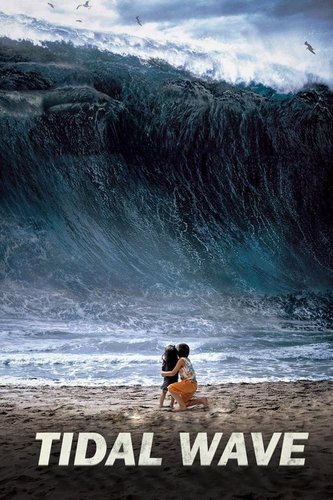
Tidal Wave

Tidal Wave

Movie · 1973 · 11 people

Tidal Wave is the American release title of Nihon Chinbotsu (literally “Japan Sinks”), a disaster picture made in 1973 at Toho, with elements of science fiction and action. It also circulates as Submersion of Japan, and in German as Der Untergang Japans. Shirō Moritani directed; the running time is 98 minutes. The story comes from Sakyo Komatsu's novel Japan Sinks, published the same year, and Komatsu wrote the screenplay together with Shinobu Hashimoto.

The plot centres on the geophysicist Dr. Tadokoro and the submarine pilot Onodera, who realise that the sea floor beneath the Japanese islands has begun to give way. Their warnings are first brushed aside, then confirmed by volcanic eruptions and a ruinous earthquake; the government concludes the country is lost and opens international talks to get its people out. Keiju Kobayashi, Hiroshi Fujioka and Ayumi Ishida lead the cast.

It was the first Japanese film to bring in leading geophysicists, seismologists, oceanographers and volcanologists as advisers, and that backing probably helps the disaster scenes feel convincing. At home it did very well at the box office, earning around 4.47 billion yen. In 1975 Roger Corman cut it down, added new footage and showed it in the United States as Tidal Wave; German cinemas first showed the film on 7 November 1974.

DirectorShirō Moritani
Production companyToho

Reactions

You can pick up to 3 reactions.

Cast

Only cast members with a profile on this site are listed.

Andrew Hughes Actor · 1908 – 1996 Keiju Kobayashi Hiroshi Fujioka Ayumi Ishida Tetsurō Tamba Lorne Greene Shōgo Shimada Nobuo Nakamura Haruo Nakajima Hideaki Nitani Isao Natsuyagi

Through different eyes

Action & Thriller Fan Puts pace, tension and set pieces first; little patience for slow drama.

The scale is huge: not one city at risk but an entire country. Volcanic eruptions and a devastating earthquake give disaster fans plenty of material for the big set pieces they want. The scientific advisers seem to have helped those scenes look convincing, too. But part of the story deals with government decisions and international negotiations, and those stretches may be talky lulls where the pace drops.

Cinephile Looks at script, editing and directing choices; keeps a distance from formula films.

Before discussing Tidal Wave, you need to know which version you watched. The cut Roger Corman shortened, padded with new footage and released in the US in 1975 is a different work from the Japan Sinks that Shirō Moritani made for Toho; an edit whose rhythm and emphasis have passed through someone else's hands risks breaking the whole the director designed. It is notable that the original screenplay was written by Sakyo Komatsu with Shinobu Hashimoto: having the novelist shape the adaptation of his own story gives the chance to build the disaster not just as spectacle but as a drama of decisions and letting go. Working with scientific advisers was also a claim to realism the genre had rarely pursued until then. If possible, choose the original version.

History & Society Lens Asks about the period, the social background and what the work reflects.

What is most striking about Japan Sinks is that it frames the disaster less as a natural event than as a society facing its own disappearance. The government accepting that the country is lost and opening international talks to evacuate its people puts on the table the idea of an entire nation becoming migrants. The warnings first being brushed aside is a familiar observation about the tension between science and politics. Earning around 4.47 billion yen at home shows how strongly that anxiety resonated with Japanese audiences. Yet since American audiences saw Corman's altered version, one wonders how much of this social layer actually reached them.

These are not reader reviews: they are short editorial takes written from different viewer perspectives with AI assistance. Reader reviews are below.

Reviews (0)

Log in Log in to write a review.

Comments