Ten to Eleven (11e 10 Kala)

Ten to Eleven (11e 10 Kala) (translated)

Movie · 2009 · 9 people

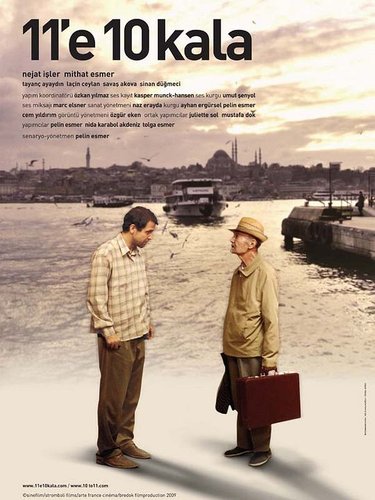
Pelin Esmer wrote and directed 10 to 11 (11'e 10 Kala in Turkish), a drama released on September 25, 2009. A co-production between Türkiye, Germany and France, it is Esmer's first narrative feature; she had earlier portrayed the same man in a short film, "Koleksiyoncu". At the 16th Altın Koza Film Festival it won Best Screenplay and shared the Best Film prize with Köprüdekiler.

The story unfolds in Istanbul's old Emniyet Apartment building. Mithat Bey, a retired civil servant, has given his life to collecting, even giving up marriage, and his newspaper archive of more than fifty years is the building's bone of contention. The residents fear earthquakes and want the block demolished, while Ali, the caretaker, stands to lose his job. One wants to save a collection, the other a livelihood, and the two men end up changing each other's fate. Mithat Esmer plays Mithat Bey and Nejat İşler plays Ali, with Tayanç Ayaydın, Laçin Ceylan, Savaş Akova and Selen Uçer among the cast.

The film is drawn from the real life of the director's uncle, Mithat Esmer, who took the lead himself. Sine Film produced it, with Nida Karabol Akdeniz, Pelin Esmer and Tolga Esmer credited as producers and Özgür Eken as cinematographer. It runs about 110 minutes.

DirectorPelin Esmer
Production companySine Film
Ten to Eleven (11e 10 Kala)

Reactions

You can pick up to 3 reactions.

Cast

Also in the cast: Mithat Esmer (Mithat Bey)

Through different eyes

Cinephile Looks at script, editing and directing choices; keeps a distance from formula films.

Pelin Esmer's first narrative feature blurs the line between documentary and fiction with real skill. Having Mithat Bey played by the director's uncle Mithat Esmer himself, whose life inspired the film, brings an authenticity few professional actors could easily reach, and Nejat İşler gives him a well-judged counterweight as the caretaker Ali. Set in the Emniyet Apartment building, the story pits the two men's interests against each other almost symmetrically. Özgür Eken's camerawork turns the building and Mithat Bey's archive into characters of their own. But 110 minutes is a little long for such a spare story; the rhythm sags in the middle and some scenes repeat the same idea. The Best Screenplay award at Altın Koza still looks well deserved.

History & Society Lens Asks about the period, the social background and what the work reflects.

11'e 10 Kala manages to tell the story of Istanbul's transformation through a single apartment block. An old building the residents want demolished out of fear of earthquakes; on one side a retired civil servant trying to save a newspaper archive spanning more than fifty years, on the other a caretaker afraid of losing his job. These two men make concrete how memory and the struggle to earn a living collide in the city, and how class difference settles into the order of an apartment building. Seen alongside today's debates over urban renewal, the film gains further meaning. It does not push a thesis; it watches its characters and leaves the viewer to think.

Yeşilçam Nostalgic A viewer raised on the classics, looking for warm storytelling and strong acting.

Mithat Bey, who has devoted his life to his collection and his newspaper archive, recalls the gentlemen of old Istanbul and is a character who tugs at the heart. That the film is inspired by a real life, and that the man who lived it plays the part himself, gives it a special sincerity. His bond with the caretaker Ali is like two different worlds touching. For an eye raised on Yeşilçam's warm, music-filled storytelling, though, the pace is quite slow; the emotions are lived in silence rather than out loud. To the patient viewer it offers a delicate story.

These are not reader reviews: they are short editorial takes written from different viewer perspectives with AI assistance. Reader reviews are below.

Reviews (0)

Log in Log in to write a review.

Comments