Çete

Gang (Çete) (translated)

Movie · 1950 · 3 people

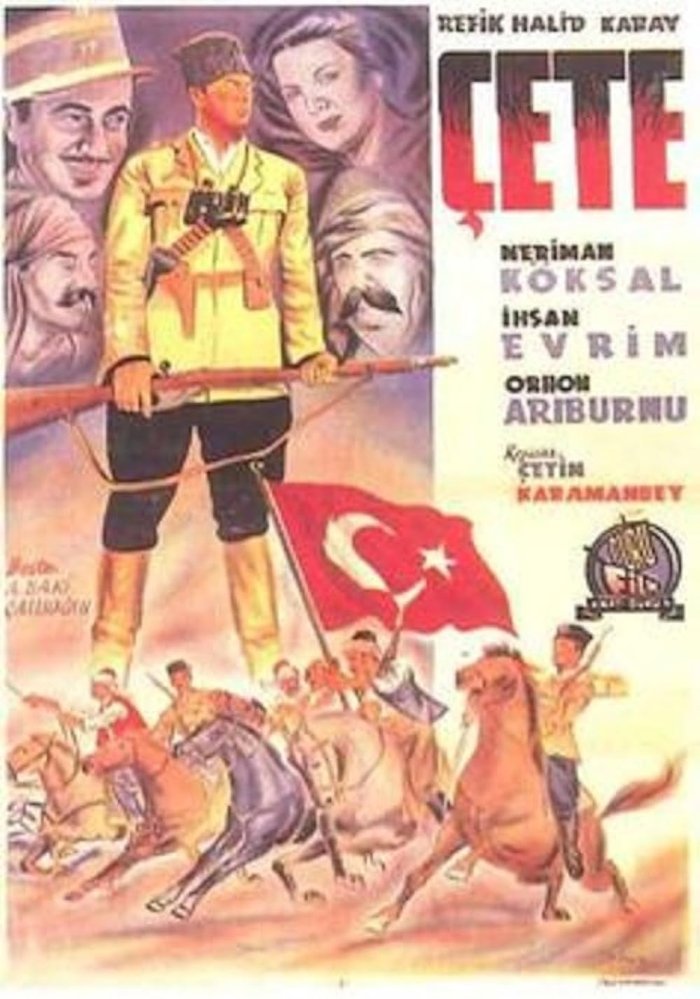
Refik Halit Karay's novel of the same name was the source for Çete ("Gang"), a black-and-white Turkish film from 1950. Combining adventure, war, drama and history, it runs about 90 minutes. Adapted from a novel, the story is set during the Turkish War of Independence.

Its heroine is Nina Danilovich, a princess of the Russian court who, after marrying the Frenchman Ernestie, lives in Syria. She wants to claim a treasure in Adana, and while pursuing that goal falls in love with Kıran Bey, a guerrilla band commander. Neriman Köksal plays Nina in her first film, and İhsan Evrim plays Kıran Bey. The cast also includes Hulusi Kentmen, Ahmet Danyal Topatan, Atıf Kaptan, Orhon Murat Arıburnu, Kadri Ögelman, Yılmaz Duru, Oktar Durukan, Nazım İnan, Bülent Ufuk and Ceyda Karasu.

Çetin Karamanbey directed and wrote the screenplay, with Naci Duru producing for Duru Film. Onnik Kalustyan was cinematographer, Ahmet Baki Çallıoğlu composed the music and Firuz Aşkın designed the poster.

DirectorÇetin Karamanbey
Production companyDuru Film

Reactions

You can pick up to 3 reactions.

Cast

Through different eyes

Yeşilçam Nostalgic A viewer raised on the classics, looking for warm storytelling and strong acting.

Seeing a novel by a master like Refik Halit Karay on screen is a special pleasure for anyone who loves literature. In a story reaching back to the War of Independence, Nina, a Russian princess chasing a treasure in Adana, giving her heart to the band commander Kıran Bey is a colourful adventure worthy of Karay. That this was Neriman Köksal's first film is a sweet detail for the curious. It would be unfair to expect today's fluency from a 1950 film, and those who have read the novel will not be able to resist comparing. As a black-and-white period adventure, it deserves attention.

History & Society Lens Asks about the period, the social background and what the work reflects.

Çete builds a story reaching back to the War of Independence around an unusual heroine: a princess of the Russian court who married a Frenchman and lives in Syria. That identity recalls a tangled geography where people from many countries crossed paths in those years. The romance between Nina, after a treasure in Adana, and the band commander Kıran Bey frames the meeting of foreigner and local as a love story. As adventure and romance take the lead, the complex reality of the period may well recede into the background, and how far the novel's historical ground survives is open to debate. Still, it is a valuable example of how the cinema of 1950 looked back at that era.

Cinephile Looks at script, editing and directing choices; keeps a distance from formula films.

Writing his own script, Çetin Karamanbey tries to fit adventure, war, drama and history into the same 90 minutes, which brings the risk of losing focus while transferring a novel's layers. Even so, the trio of princess, treasure and band commander offers an adventure skeleton well suited to cinema. Onnik Kalustyan's black-and-white cinematography is something to watch closely when looking at films of the period. That this was Neriman Köksal's first film also offers the chance to see an actor's first step onto the screen. For today's viewer the real question is what was gained and what was sacrificed in moving from page to screen. A valuable document for those who approach early Turkish cinema with an archaeologist's curiosity.

These are not reader reviews: they are short editorial takes written from different viewer perspectives with AI assistance. Reader reviews are below.

Reviews (0)

Log in Log in to write a review.

Comments