Wound of Heartbreak (Hicran Yarası)

Wound of Heartbreak (Hicran Yarası) (translated)

Movie · 1959 · 3 people

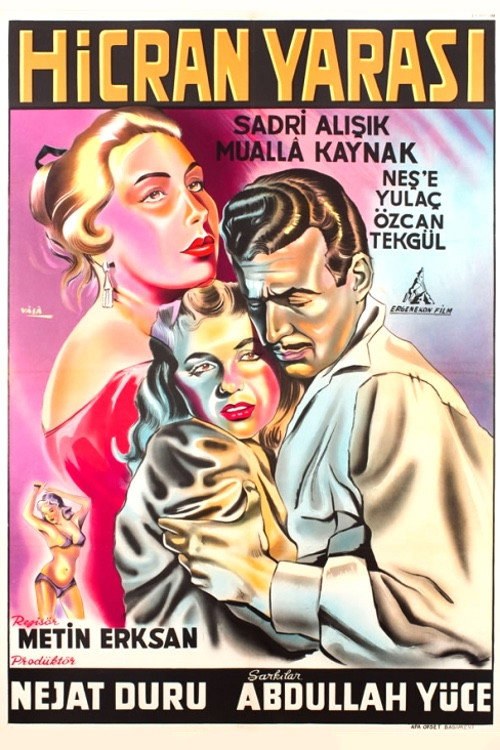
A black-and-white Turkish drama from 1959, Hicran Yarası (The Wound of Separation) was directed by Metin Erksan. The story of a street singer caught between love and poverty, it starred Sadri Alışık and became one of the two most-watched films of its year. It is also noted as the first time Erksan took up the theme of obsessive, doomed love. Every print of the film was later destroyed in a fire, and no copy is known to survive.

Alışık plays Ali, a young man who shares a shanty-town house with two friends and earns his living singing in the streets. Trouble begins when he and the girl he loves decide to marry, for she is not the only one drawn to him: Özcan, a belly dancer from next door, and a wealthy widow who promises to make him famous are both pursuing him. Ali's indifference to the widow sends events in a dark and unexpected direction, while hardship puts the lovers to the test. Mualla Kaynak (Şükran), Neşe Yulaç, Özcan Tekgül and Kadir Savun complete the cast.

Erksan wrote the screenplay with İsmail Avşar; Nazif Duru produced and Kemal Akkavuk was director of photography. The film runs about 135 minutes.

DirectorMetin Erksan

Reactions

You can pick up to 3 reactions.

Cast

Also in the cast: Neşe Yulaç
Through different eyes

Yeşilçam Nostalgic A viewer raised on the classics, looking for warm storytelling and strong acting.

Hicran Yarası is one of those films we have heard of but can never see; every print was lost in a fire. Sadri Alışık's Ali, earning his living singing in the streets, the shanty town, poverty and doomed love... the veins of Yeşilçam I cherish most all meet in this story. That it was one of the two most-watched films of its year tells how audiences took to that warmth. It aches to think of a film that lives on only in descriptions; how I would love to hear those street songs just once.

Cinephile Looks at script, editing and directing choices; keeps a distance from formula films.

Writing about a lost film begins with accepting the limits of criticism: nobody today can directly assess the editing of Hicran Yarası, Kemal Akkavuk's black-and-white images or how Erksan staged his scenes. What remains is the skeleton of a story. That skeleton matters as the first time Erksan took up the theme of obsessive, doomed love. On the other hand, its street singer, a young man pursued by more than one woman and a wealthy widow promising to make him famous sit quite close to the melodrama molds of the day, and a running time of about 135 minutes hints that the mold may have been stretched. The real loss is that we can no longer know what Erksan did differently inside that formula.

History & Society Lens Asks about the period, the social background and what the work reflects.

The story of Hicran Yarası holds a familiar picture of 1959 Türkiye: a young man living in a shanty-town house with two friends and making his living singing in the streets. Love tested by poverty, and a promise of fame that in a wealthy widow's hands becomes almost a bargain, offer a frame for seeing how class difference seeps into matters of the heart. That it was one of the two most-watched films of its year suggests audiences found something of themselves in this world. The loss of every print in a fire is a bitter reminder of how fragile film heritage is.

These are not reader reviews: they are short editorial takes written from different viewer perspectives with AI assistance. Reader reviews are below.

Reviews (0)

Log in Log in to write a review.

Comments