Moderato cantabile (film)

Seven Days... Seven Nights (Moderato cantabile)

Movie · 1960 · 6 people

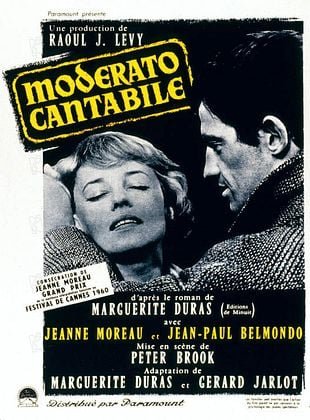
Peter Brook directed Moderato cantabile, a black-and-white French-Italian drama from 1960. Adapted from Marguerite Duras's novel of the same name, published in 1958, it is known in English-speaking countries as Seven Days... Seven Nights and in German as Stunden voller Zärtlichkeit. The film runs about 88 minutes, joins drama with romance, and takes its title from a musical direction, moderato cantabile, meaning moderately and in a singing style.

The story is set in a small port town. Anne Desbarèdes, the wife of a wealthy industrialist, is stifled by her monotonous bourgeois life. A murder committed in a café draws her in obsessively; she begins returning to the place where it happened and there meets Chauvin, a worker. Their repeated meetings grow into an intense but ambiguous closeness. Jeanne Moreau and Jean-Paul Belmondo share the leading roles, with Pascale de Boysson, Colette Régis, Didier Haudepin and Jean Deschamps also in the cast.

The film was selected for competition at the 1960 Cannes Film Festival, and Jeanne Moreau won the festival's Best Actress award for her role.

DirectorPeter Brook

Reactions

You can pick up to 3 reactions.

Cast

Only cast members with a profile on this site are listed.

Jeanne Moreau Jeanne Moreau Film actor · died at 89 Jean-Paul Belmondo Jean-Paul Belmondo Film actor · died at 88 Colette Régis Didier Haudepin Jean Deschamps Pascale de Boysson

Through different eyes

Cinephile Looks at script, editing and directing choices; keeps a distance from formula films.

Taking its title from a musical direction meaning moderately and in a singing style, the film announces from the outset that it will be built on rhythm more than incident. The café murder is not a crime-story knot here but a crack opening in Anne's monotonous bourgeois life; what matters is not the crime itself but why she fixates on it so. A structure built on repeated meetings is the right tool for an intimacy that stays intense yet ambiguous. That is also the difficulty: a narrative that deliberately preserves ambiguity can feel static and aimless to an impatient viewer. Moreau's Cannes award suggests that much of the film's weight rests on her face rather than on words.

History & Society Lens Asks about the period, the social background and what the work reflects.

Beneath the story lies an open class tension: the wife of a wealthy industrialist and a worker meet in a café in a small port town. Anne's suffocation in her bourgeois life can be read as a familiar portrait of women confined to home and status in the Europe of the 1950s and 60s. Her compulsion to return to the scene of the murder seems to stand for a wish to step out of a sheltered world toward a life seen as dangerous and beneath her. How such a cross-class closeness would be received around them also hovers constantly in the background. For anyone who wants to see a woman's inner unrest as a quiet problem of its era, it is a fine example.

Family Viewer Asks whether the whole household can watch it; cares about humour and heart.

This is not a film for family viewing; it is strictly for adults. Its starting point is a murder and a married woman's ambiguous closeness with a stranger. There is little incident and a lot of talk and glances. Children will be bored, and teenagers will probably grow restless. It suits adults who like slow, thoughtful older European films.

These are not reader reviews: they are short editorial takes written from different viewer perspectives with AI assistance. Reader reviews are below.

Reviews (0)

Log in Log in to write a review.

Comments