Parmaksız Salih

Salih Without Fingers (Parmaksız Salih) (translated)

Movie · 1950 · 3 people

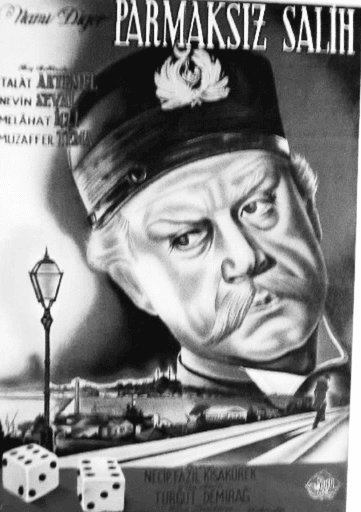
Black-and-white Turkish drama Parmaksız Salih ("Fingerless Salih") dates from 1950 and was directed by Faruk Kenç. It is based on the stage play Nâm-ı Diğer Parmaksız Salih by the poet and writer Necip Fazıl Kısakürek, who is credited with the screenplay. Turgut Demirağ produced for And Film, and Kemal Baysal was the cinematographer.

At its centre is Salih, who got his nickname from the finger he lost to gambling. He runs a gambling house, yet voices the dark side of gambling that its players try to ignore. For years he has searched for his lost son. When he finally meets Yusuf, he is himself deep in the vice that ruined his life. He runs after Yusuf hoping to save what is left, but he is too late: Yusuf has recently fallen into a trap laid for someone else, with Salih's own help. All that remains is what he can do for his grandchild and daughter-in-law. In the play's last scene Yusuf learns, at the same moment, that he is Salih's son and what the way to redemption is.

Talat Artemel plays Salih. The cast also includes Muzaffer Tema, Cahit Irgat, Nevin Seval and Vahit Öz.

DirectorFaruk Kenç
Production companyAnd Film

Reactions

You can pick up to 3 reactions.

Cast

Through different eyes

Yeşilçam Nostalgic A viewer raised on the classics, looking for warm storytelling and strong acting.

Adapted from Necip Fazıl Kısakürek's stage play, this black-and-white drama is a precious trace from the early years of Turkish cinema. It shows what gambling takes from a person through a lost son and a remorse that comes too late, and its moral centre is very strong. Talat Artemel's Salih is a tragic figure who describes to others the very pit he has fallen into. Its stage origins may at times be too visible, and the dialogue can grow heavy, close to a sermon; but this trial between sin and redemption will deeply move anyone who loves the cinema of the old masters.

History & Society Lens Asks about the period, the social background and what the work reflects.

Parmaksız Salih is an interesting document for understanding how gambling was seen as a social wound in the Turkey of 1950. Salih, who runs a gambling house yet speaks of gambling's dark side, is a contradictory figure: part of the system and its critic at once. A lost son, a scattered family and the grandchild and daughter-in-law left behind show that the price of gambling is paid not only by the player but by the whole family. The emphasis on salvation and redemption in a story drawn from Necip Fazıl Kısakürek's play carries traces of the writer's moral world; today's viewer does best to read that moralising tone in the context of its time.

Cinephile Looks at script, editing and directing choices; keeps a distance from formula films.

In bringing Kısakürek's play to the screen, Faruk Kenç seems to keep much of its stage structure; the narrative relies less on cinematic rhythm than on dramatic charges built scene by scene. Kemal Baysal's black-and-white photography offers a fitting ground for this gloomy world. The script's real strength is its tragic irony: a trap laid for someone else, with Salih's own help, catches the very son he has spent years searching for. Irony of that kind is one of melodrama's most effective tools, and it is well set up here. Yet spelling out the moral lesson so openly drains the tension; rather than leaving the viewer room to think, the film announces its conclusion up front.

These are not reader reviews: they are short editorial takes written from different viewer perspectives with AI assistance. Reader reviews are below.

Reviews (0)

Log in Log in to write a review.

Comments