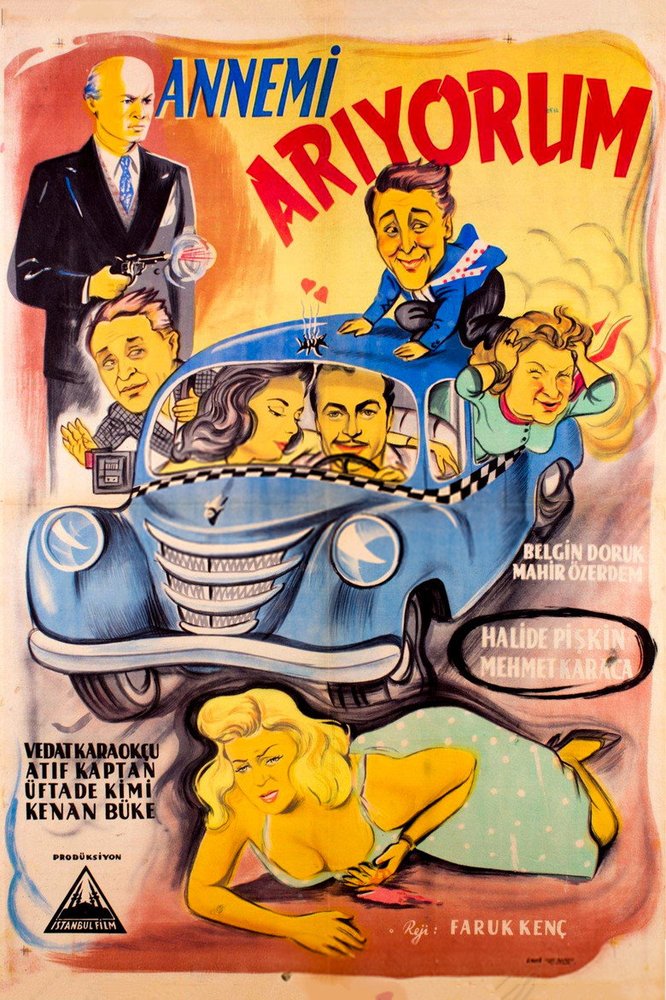
Annemi Arıyorum

I'm Looking for My Mother (Annemi Arıyorum) (translated)

Movie · 1959 · 3 people

A Turkish drama from 1959, Annemi Arıyorum (I'm Looking for My Mother) was shot in black and white and runs about ninety minutes. Faruk Kenç wrote and directed it for Şan Film, and it belongs to the family-melodrama tradition of its period. At its centre is a young woman's attempt to find the mother who walked out on the family and bring her home.

Belgin lives in İzmir with her father and her sister. When her mother runs off to Istanbul with another man, Belgin follows her trail to the big city. Belgin Doruk plays the title heroine, with Mahir Özerdem, Halide Pişkin, Mehmet Karaca, Kenan Büke, Üftade Kimi, Atıf Kaptan and Kadir Savun in the cast. Vedat Karaokçu plays Belgin's father Haluk, Atıf Kaptan is Reşit Kaptan, Üftade Kimi is Nermin and Kenan Büke is Köstebek Kenan. The search leads through Istanbul's boarding houses, gambling dens and casino circles, a world of jealousy, deceit and illegal business.

Baki Üsküdarlı produced the film and Kazım Koşkan was the cinematographer. Nevin Akkaya dubbed the voice of Belgin Doruk, and Aynur Akın appears as herself.

DirectorFaruk Kenç
Production companyŞan Film

Reactions

You can pick up to 3 reactions.

Cast

Through different eyes

Yeşilçam Nostalgic A viewer raised on the classics, looking for warm storytelling and strong acting.

A black-and-white family melodrama has a warmth all its own, and Annemi Arıyorum walks that line. Faruk Kenç turns a daughter's search for the mother who walked out into a journey from İzmir to the boarding houses and gazinos of Istanbul. The innocence Belgin Doruk brings is the film's heart. That her voice was dubbed by Nevin Akkaya recalls Yeşilçam's familiar dubbing tradition. To today's eyes the melodrama may feel heavy, but this story built on family love and loyalty promises a heartfelt evening for lovers of old films.

Family Viewer Asks whether the whole household can watch it; cares about humour and heart.

The story is about a mother leaving her family and her daughter going to find her, so it is a heavy family matter. The film moves through gambling dens, gazinos, jealousy, cheating and crime. It is not for small children, and it could be hard to explain to them. Older teens can watch it with adults. Grandparents who love old black-and-white films will enjoy it; younger viewers may find it slow.

History & Society Lens Asks about the period, the social background and what the work reflects.

Released in 1959, the film puts a mother who abandons her family at its centre, a striking subject for its time. The story sets the family home in İzmir against Istanbul's world of boarding houses, gambling dens and gazinos; the big city is drawn as a place of jealousy, deceit and crime. The young woman who sets out to bring her mother back plainly reflects the era's expectation that the family must be held together. Today's viewer may wonder how much room the melodrama leaves for the mother's own side, but that very outlook is a valuable record of late-1950s ideas about family and morality.

These are not reader reviews: they are short editorial takes written from different viewer perspectives with AI assistance. Reader reviews are below.

Reviews (0)

Log in Log in to write a review.

Comments