The Tattoo

The Tattoo (Le Tatoué)

Movie · 1968 · 15 people

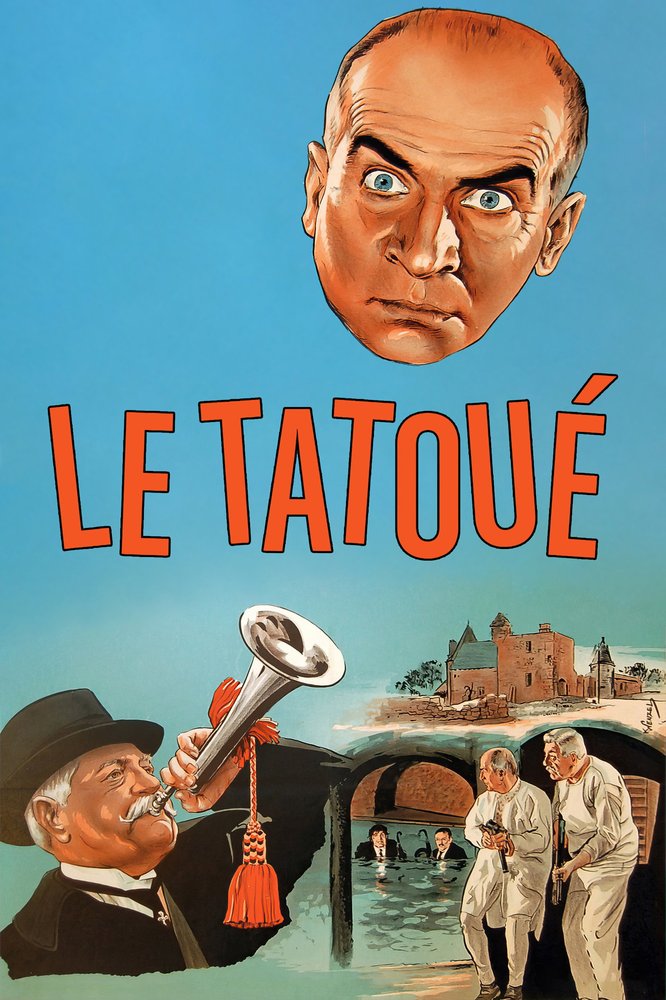
Denys de La Patellière directed the 1968 French-Italian comedy Le Tatoué (The Tattoo), shown in Germany as Balduin, das Nachtgespenst. Its main attraction was bringing Jean Gabin and Louis de Funès together as a comic duo for the first time. Producer Maurice Jacquin, counting on the two actors' enormous popularity, conceived it as a commercial coup. It runs about 89 minutes.

The story follows the art dealer Félicien Mezeray (de Funès), who will stop at nothing to buy a Modigliani tattoo on the back of a former legionnaire named Legrain (Gabin), offering to renovate his country house in exchange. He does not know that the house is a ruined twelfth-century château, or that Legrain is in fact a penniless count. Jean-Pierre Darras is also in the cast.

The script was troubled: Alphonse Boudard gave up on it, dialogue writer Pascal Jardin stepped in, and scenes were shot in story order as he wrote them day by day. Filming ran from 15 February 1968 to April, at the Château de Paluel in the Dordogne. Reviews were lukewarm, yet the film was the hit of autumn 1968, with over 3.2 million admissions and eighth place among the year's releases.

DirectorDenys de La Patellière
Production companyLes Films Copernic

Reactions

You can pick up to 3 reactions.

Cast

Only cast members with a profile on this site are listed.

Jean-Pierre Darras Jean-Pierre Darras Film actor · died at 71 Pierre Repp Pierre Repp Actor · died at 76 Louis de Funès Jean Gabin Lyne Chardonnet Michel Tureau Patrick Préjean Henri Virlogeux Dominique Davray Hubert Deschamps Ibrahim Seck Iska Khan Jacky Blanchot Jacques Richard Jean-Pierre Sentier
Through different eyes

Cinephile Looks at script, editing and directing choices; keeps a distance from formula films.

The film is built less on a script than on a casting idea: putting Jean Gabin and Louis de Funès side by side as a comic duo for the first time. That contrast is the film's real engine, and the moments when the two acting styles collide are where the entertainment comes from. The script's troubled writing shows, though: when dialogue is written day by day and scenes are shot in story order, you naturally get a string of situations rather than a well-shaped structure. In my view that looseness explains the lukewarm reviews, while over 3 million admissions show that the stars' pull outweighed the script.

History & Society Lens Asks about the period, the social background and what the work reflects.

At its core the story mocks a world where art has become a commodity: an art dealer will stop at nothing to buy a Modigliani tattoo off a former legionnaire's back. A human body turned into a bargaining object is a fairly sharp idea underneath the comedy. On the other side stand a ruined twelfth-century château and a penniless count, an aristocracy that has kept its title but lost its fortune. The meeting of dealer and count stages the rivalry between new money and old nobility in a light register. For viewers who notice that layer, the film is more than a star comedy.

Family Viewer Asks whether the whole household can watch it; cares about humour and heart.

A light comedy from classic French cinema: the story is a bargain over a tattoo and a château, and nothing in the summary looks heavy or frightening. Since the main fun is two seasoned actors sparring, the laughs speak more to adults and teenagers. Small children may find the haggling between an art dealer and an old legionnaire dull. A good pick for parents who like old comedies and their teenage kids.

These are not reader reviews: they are short editorial takes written from different viewer perspectives with AI assistance. Reader reviews are below.

Reviews (0)

Log in Log in to write a review.

Comments