War of the Buttons

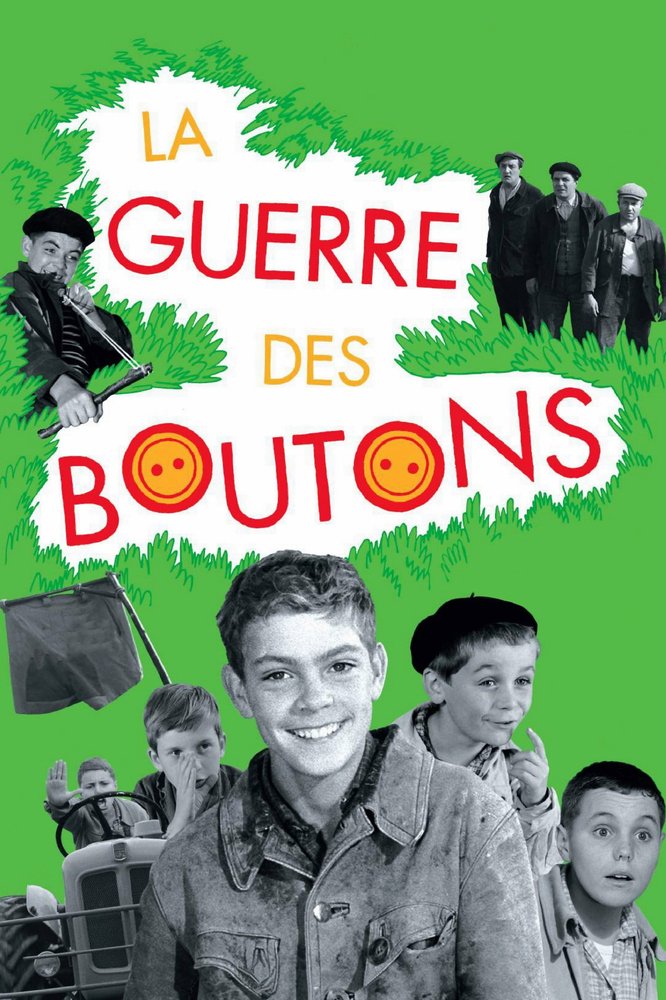
War of the Buttons (La Guerre des boutons)

Movie · 1962 · 15 people

Yves Robert directed the 1962 French comedy La Guerre des boutons (War of the Buttons). It is drawn from the 1912 novel of the same name by the Franche-Comté writer Louis Pergaud and is the second of five film versions of the book. The script is credited to François Boyer and Pergaud, and the production company is Les Productions de la Guéville. The 91-minute film won the Prix Jean Vigo and the award for best French film at the Victoires du cinéma français.

The story follows a feud between the boys of two neighbouring villages. The rival gangs cut buttons from each other's clothes and keep them as war trophies, which gives the film its title. The children are mostly played by young, inexperienced actors: André Treton as Lebrac, Michel Isella as l'Aztec and Martin Lartigue as Petit Gibus. Among the adults are Jean Richard, Michel Galabru and Jacques Dufilho.

Pergaud was killed at the front in 1915, and his writing is markedly anti-militarist. Petit Gibus's frustrated, ungrammatical "si j'aurais su, j'aurais pas v'nu" is not in the novel, yet it became a well-known saying in France. The story was later remade in Ireland in 1994, and again in France in 2011 under its original title.

DirectorYves Robert
Production companyLes Productions de la Guéville

Reactions

You can pick up to 3 reactions.

Cast

Only cast members with a profile on this site are listed.

Jacques Dufilho Jacques Dufilho Actor · died at 91 Michel Galabru Michel Galabru Film actor · died at 93 Jean Richard Paul Crauchet André Treton Martin Lartigue Christophe Bourseiller Claude Confortès Daniel Janneau François Boyer François Lartigue Henri Labussière Louisette Rousseau Pierre Tchernia Pierre Trabaud
Through different eyes

Family Viewer Asks whether the whole household can watch it; cares about humour and heart.

A feud between the children's gangs of two neighbouring villages is the kind of game kids will instantly feel part of. But it is worth a word of explanation when watching with little ones: the fights and cutting buttons off rivals' clothes are not a game to copy in real life. It can be enjoyed together by middle-school children and grandparents alike, and it can open a nice conversation afterwards about fighting, peace and friendship.

History & Society Lens Asks about the period, the social background and what the work reflects.

Knowing that Louis Pergaud died at the front in 1915 gives this little war over button trophies a very different meaning. The rivalry between villages scales adult notions like honour, loyalty and spoils down to children's size, and so shows how arbitrary, even absurd, the passion for war is. The author's anti-militarism comes through the comedy rather than through preaching. That the story was remade in Ireland in 1994 and again in France in 2011 suggests this rural allegory of childhood still resonates across societies and eras.

Cinephile Looks at script, editing and directing choices; keeps a distance from formula films.

Yves Robert's most striking decision is to cast the children's roles largely with inexperienced young actors. Avoiding the artificial polish of professional child acting gives the film the chance of an almost documentary liveliness; that Petit Gibus's ungrammatical line, which is not even in the novel, became a common saying in France shows how strongly that naturalness connected with audiences. The Prix Jean Vigo signals that the film was taken seriously beyond being a popular comedy. My reservation: a structure built on clashes between gangs tends to repeat itself through one encounter after another, and in my view the adult characters stay on the edge of the story despite the strong names in the cast.

These are not reader reviews: they are short editorial takes written from different viewer perspectives with AI assistance. Reader reviews are below.

Reviews (0)

Log in Log in to write a review.

Comments