Pardon Mon Affaire

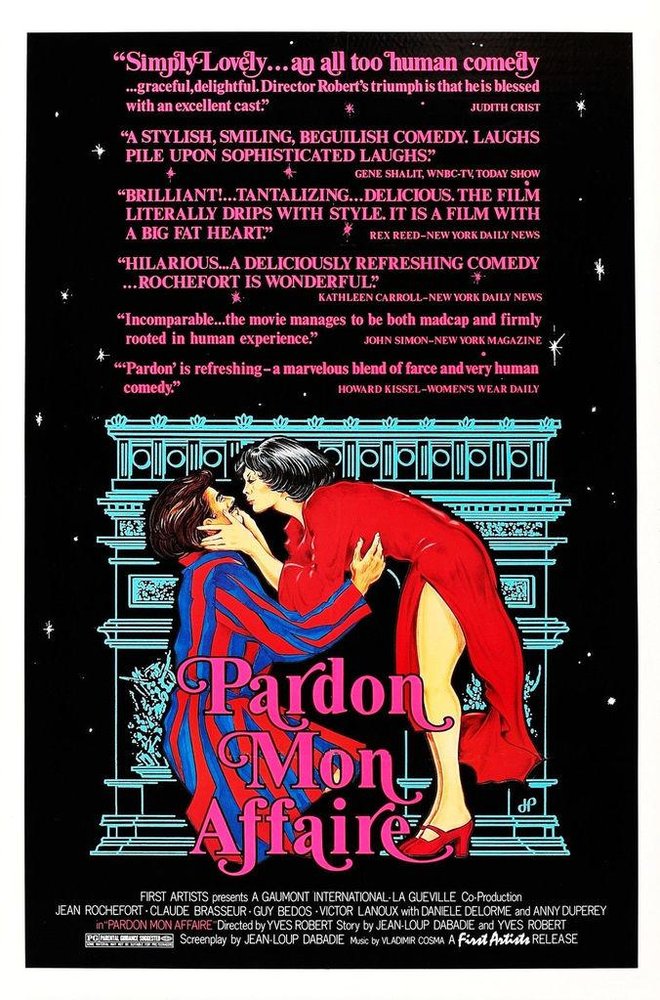
Pardon Mon Affaire (Un éléphant ça trompe énormément)

Movie · 1976 · 15 people

Yves Robert wrote Pardon Mon Affaire, originally Un éléphant ça trompe énormément, with Jean-Loup Dabadie and directed it as a 1976 French romantic comedy. The French title hides a pun: "trompe" means both an elephant's trunk and cheating. The film was a huge hit in France and abroad, and Gene Wilder directed and starred in an American remake, The Woman in Red, in 1984.

The story centres on four tennis-loving friends in their forties, each facing a difficult situation in his private life. In writer Dabadie's words, it chronicles the stormy dealings of certain men with certain women who are not necessarily their own. The plot is driven by a married man's wish to have an affair with a model he has just met. The friends are played by Jean Rochefort, Claude Brasseur, Guy Bedos and Victor Lanoux, with Danièle Delorme, Anny Duperey and Marthe Villalonga in the main female roles.

Claude Brasseur won the 1977 César for Best Supporting Actor for playing one of French cinema's first positive gay characters. Les Productions de la Guéville produced the film, which runs about 105 minutes. Robert followed it in 1977 with the sequel Nous irons tous au paradis.

DirectorYves Robert
Production companyLes Productions de la Guéville

Reactions

You can pick up to 3 reactions.

Cast

Only cast members with a profile on this site are listed.

Victor Lanoux Victor Lanoux Film actor · died at 80 Jean-François Dérec Jean-François Dérec Actor · 69 years old Jean Rochefort Claude Brasseur Danièle Delorme Anny Duperey Guy Bedos Maurice Bénichou Anémone Anne-Marie Blot Bernard Charlan Christophe Bourseiller Gerald Calderon Jean Lanier Jean Lescot

Through different eyes

Cinephile Looks at script, editing and directing choices; keeps a distance from formula films.

Yves Robert and Jean-Loup Dabadie's script spreads a single adultery story across a group portrait of four friends, and that ensemble structure is the film's real achievement. The married man's desire for a model he has just met drives the plot, but the rhythm comes from the back-and-forth among the friends. The pun in the title sums up the tone well: light, playful and gently mocking its own heroes. The weakness, as I see it, is that the four men's troubles are not explored with equal depth, and some side threads stay at sketch level. That an American remake was made proves the strength of the idea, yet the structure depends heavily on the light touch of French ensemble comedy.

History & Society Lens Asks about the period, the social background and what the work reflects.

The film holds a mirror to French middle-class masculinity in the seventies: four men in their forties whose private lives are a mess. In the screenwriter's own words, it chronicles men's dealings with women who are not necessarily theirs; in my view that outlook casts the female characters largely as objects of male desire, and it looks dated today. On the other hand, the character played by Claude Brasseur stands out as one of French cinema's first positive gay portrayals, recognised with a César. The film thus carries both the conservative side of its era and the side that was starting to change.

Family Viewer Asks whether the whole household can watch it; cares about humour and heart.

This is not a family film. At its centre is a married man's wish to have an affair, and cheating in general. The humour may be light, but the subject is strictly for adults. Better for an evening with your partner or friends than with the children. Teenagers are unlikely to find much of themselves in these troubles either.

These are not reader reviews: they are short editorial takes written from different viewer perspectives with AI assistance. Reader reviews are below.

Reviews (0)

Log in Log in to write a review.

Comments