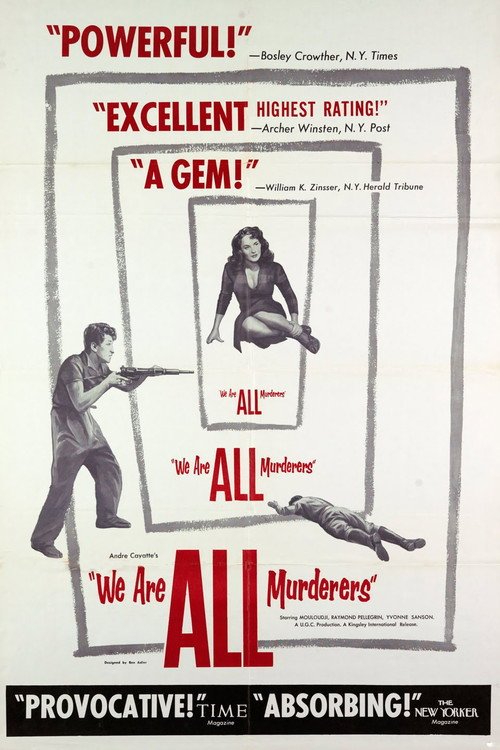
We Are All Murderers

We Are All Murderers (Nous sommes tous des assassins)

Movie · 1952 · 15 people

The French-Italian film Nous sommes tous des assassins, known internationally as We Are All Murderers (Siamo tutti assassini in Italian), dates from 1952. Sources call it a crime drama, a courtroom film and a legal drama. It is in French and runs 110 minutes. Director André Cayatte was known for work on legal subjects, and here he builds a cinematic indictment that argues for abolishing the death penalty in France. The film competed at the 1952 Cannes Film Festival, the fifth edition, and took the Special Jury Prize.

At the centre is René, a young man from the slums whom the French Resistance trained during the Second World War to fight the Germans. When the war ends he does not stop killing, because it is all he knows. The story gathers around his trial and the death sentence he faces. Marcel Mouloudji, Raymond Pellegrin and Claude Laydu star, and Antoine Balpêtré, André Valmy, Alexandre Rignault, Anouk Ferjac and André Reybaz are also named in the cast.

Cayatte wrote the screenplay with Charles Spaak. Shooting took place at the Boulogne Studios in Paris, and the sets were designed by art director Jacques Colombier.

DirectorAndré Cayatte

Reactions

You can pick up to 3 reactions.

Cast

Only cast members with a profile on this site are listed.

Guy Decomble Guy Decomble Actor · died at 53 Henri Crémieux Henri Crémieux Actor · died at 83 Marcel Mouloudji Raymond Pellegrin Alexandre Rignault André Reybaz André Valmy Anouk Ferjac Antoine Balpêtré Bernard Musson Charles Bouillaud Charles Lemontier Claude Laydu Daniel Mendaille Doudou Babet
Through different eyes

History & Society Lens Asks about the period, the social background and what the work reflects.

Cayatte's film is an early and bold intervention by cinema in the debate over the death penalty. René's story takes the problem beyond the individual: a young man from the slums who was taught to kill in wartime is put on trial for the same behaviour once peace arrives. The film thereby ties the crime not only to the person but to the conditions that shaped him and the society that made use of him. That is exactly the point of the 'all' in the title. It is also valuable as a witness to post-war France facing its own past, and the Special Jury Prize at Cannes shows how live the question was at the time.

Cinephile Looks at script, editing and directing choices; keeps a distance from formula films.

Turning the courtroom film into a thesis film is a risky move, and Cayatte collects both its reward and its price. The screenplay, written with Charles Spaak, builds the case less as a character drama than as an argument, every scene pushing the case against capital punishment one step further. It is powerful but at times too didactic: characters occasionally become spokesmen for a view rather than people. Even so, the director's background in legal subjects gives the trial scenes real solidity. Seen today, its principled courage stays with you more than its narrative subtlety.

Yeşilçam Nostalgic A viewer raised on the classics, looking for warm storytelling and strong acting.

The great strength of old French cinema was its ability to ask a large moral question through a plain human story, and this film belongs to that tradition. The trial of a young man who cannot let go of the one thing war taught him keeps the viewer from reaching an easy verdict. This is a film with a conscience at its centre, and that is exactly why it doesn't feel its age. My only reservation is that the weight of the subject and the clarity of its message sometimes push warmth into the background; still, for lovers of the black-and-white classics, a meaningful discovery.

These are not reader reviews: they are short editorial takes written from different viewer perspectives with AI assistance. Reader reviews are below.

Reviews (0)

Log in Log in to write a review.

Comments