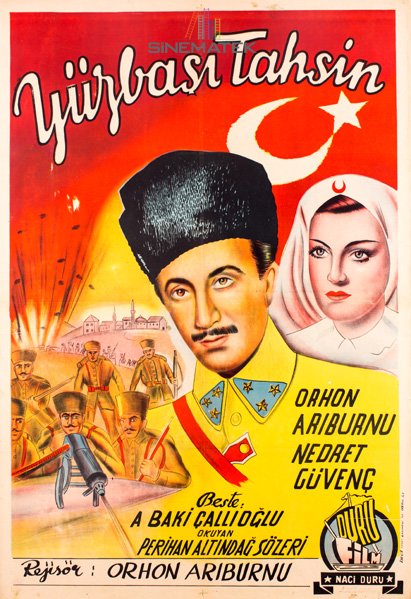
Yüzbaşı Tahsin

Captain Tahsin (Yüzbaşı Tahsin) (translated)

Movie · 1950 · 9 people

Yüzbaşı Tahsin ("Captain Tahsin"), a Turkish sentimental drama, was shot in black and white in 1950. It is based on a story by Hıfzı Tan. Director Orhon Murat Arıburnu wrote the script with Tan and also plays the title role himself. The producer is Naci Duru and the production company is Duru Film. The cinematography is by Aram Hugosyan and the film runs 101 minutes.

The story is set in July 1921, during the Turkish War of Independence. The national forces have pulled back to Sakarya. Villagers near Kuyucak who blew up an enemy ammunition column are rounded up to be shot in the square. A cavalry unit under Captain Tahsin storms the village and saves them. Badly wounded, Tahsin is found by a shepherd, and the village teacher Belkıs treats him. The captain has lost his memory, and the villagers call him "Our Boy." Belkıs writes to her fellow teacher Pakize in Eskişehir, asking her to send a doctor. Meanwhile Tahsin and Belkıs fall in love, yet the captain is in fact Pakize's husband, believed dead.

Nedret Güvenç plays Belkıs and Belkıs Dilligil plays Pakize. The writer known as Halikarnas Balıkçısı, Cevat Şakir Kabaağaçlı, appears as the chief physician of the Red Crescent hospital. The cast also includes Nuri Genç, Salih Tozan and Hayri Esen.

DirectorOrhon Murat Arıburnu
Production companyDuru Film

Reactions

You can pick up to 3 reactions.

Cast

Belkıs Dilligil Belkıs Dilligil Actor · died at 66 Orhon Murat Arıburnu Nedret Güvenç Salih Tozan Hayri Esen Halikarnas Balıkçısı Tevhit Bilge Kemal Dirim Mehmet Aslan
Through different eyes

Yeşilçam Nostalgic A viewer raised on the classics, looking for warm storytelling and strong acting.

Bringing together the heroism of the War of Independence and the romantic dilemma of a captain who has lost his memory, this film is a typical example of the emotional drama of Turkish cinema's early period. A forgotten past, love formed unknowingly and fate stepping in may seem too coincidental to today's eye, but for audiences of that time these were exactly what moved the heart. Seeing Halikarnas Balıkçısı, the writer Cevat Şakir Kabaağaçlı, as a chief physician is a small but precious surprise for literature lovers. A work that weighs love of country against personal love and carries the sincerity of its era.

History & Society Lens Asks about the period, the social background and what the work reflects.

The film tells the War of Independence through a village rather than the front: villagers who blow up the enemy's ammunition column, the cavalry unit that rescues them, and the village teacher who treats the wounded captain. It hardly seems a coincidence that both Belkıs and Pakize are teachers; in the Republic's early decades the woman teacher stood out as a figure carrying the new country's ideals. Made more than a quarter of a century after the war, the film builds its memory of those years on solidarity between the people and the army. It is worth remembering that it offers a national narrative more than historical detail.

Action & Thriller Fan Puts pace, tension and set pieces first; little patience for slow drama.

The opening promises plenty: villagers gathered to face a firing squad and a cavalry raid arriving at the last minute. But from there the story turns into a love drama more than a war film. Once memory loss, letters and a love triangle take over, the pace drops considerably. If you are after battle scenes, the film may amount to little more than a short intro; the real weight is on the emotions.

These are not reader reviews: they are short editorial takes written from different viewer perspectives with AI assistance. Reader reviews are below.

Reviews (0)

Log in Log in to write a review.

Comments