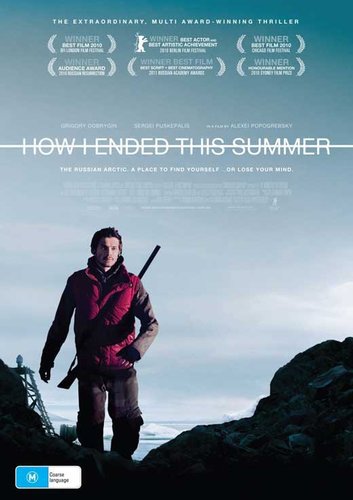
How I Ended This Summer (Kak ya provyol etim letom)

How I Ended This Summer (Kak ya provyol etim letom)

Movie · 2010 · 2 people

Alexei Popogrebski wrote and directed How I Ended This Summer (Russian Kak ya provyol etim letom), a 2010 Russian drama and psychological thriller. Made by Channel One Russia and shot in 2008-2009, it was developed under the working title Posledniy den ("The Last Day"). It had its world premiere at the Berlin Film Festival on February 17, 2010, previewed in Rostov-on-Don on March 27 and opened in Russian cinemas on April 1, 2010.

The story takes place at a small research station in the Arctic Ocean, where a young student spends a summer with an experienced but reclusive meteorologist. The relationship between the two men in this remote, closed setting is the film's core. Grigoriy Dobrygin and Sergei Puskepalis play the leads. The grammatical form of the title is a deliberate stylistic device.

It competed for the Golden Bear at the 60th Berlin Film Festival, the two leads shared the Silver Bear for Best Actor and cinematographer Pavel Kostomarov won the Silver Bear for Outstanding Artistic Contribution. The same year it took the top prize at the 54th London Film Festival and the Golden Eagle for Best Film.

DirectorAlexei Popogrebski
Production companyPervıy Kanal

Reactions

You can pick up to 3 reactions.

Cast

Names without a link have no profile here yet.

Through different eyes

AI-assisted editorial takes written from different viewer perspectives. They are not reader reviews; those are below.

Cinephile Looks at script, editing and directing choices; keeps a distance from formula films.

Popogrebski inverts the chamber thriller with the openness of the Arctic: what hems the two men in is not a cramped room but a boundless emptiness. The choice pays off through the images that won Pavel Kostomarov a Silver Bear in Berlin; the landscape is not backdrop but an extension of the tension between the characters. The two leads sharing the best actor prize confirms the film is built as a duet, with every scene resting on the balance between them. Its weakness is how slowly the psychological tension accumulates: some scenes seem to repeat themselves rather than deepen the atmosphere. That the title's grammatical form is a deliberate stylistic device shows the director's care for detail.

Action & Thriller Fan Puts pace, tension and set pieces first; little patience for slow drama.

Don't let the psychological thriller label fool you: don't expect big action scenes, because the tension here comes from two men's relationship at an isolated station. The setting is a great idea; it is hard to think of anywhere more inescapable than a small research station on the Arctic Ocean. But if you are impatient, the slow progress may test you. If you are ready for a quiet, creeping kind of tension, give it a try.

History & Society Lens Asks about the period, the social background and what the work reflects.

An experienced but reclusive meteorologist and a young student sharing one summer invites a reading about the distance between two generations. How authority, trust and communication work at a small station cut off from the world makes it something like a laboratory of a miniature society. The solitude of scientific work and what such remote postings do to people are also questions the film lets you consider in the background. It never spells these layers out and leaves the interpretation to the viewer, which both enriches a social reading and leaves it open.

Reviews (0)

Log in Log in to write a review.

Comments