İdam Sehpası

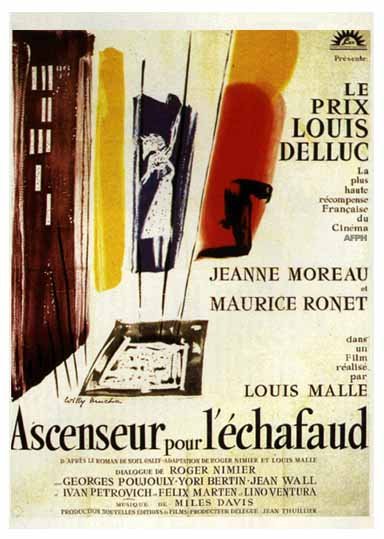
Elevator to the Gallows (Ascenseur pour l'échafaud)

Movie · 1958 · 15 people

Louis Malle was 26 when he made his first fictional feature, the 1958 French film noir and thriller Elevator to the Gallows (İdam Sehpası in Turkish). It is seen as a forerunner of the French New Wave and won the Louis Delluc Prize. It made Jeanne Moreau an international star and is remembered as well for its Miles Davis score.

The story begins with the plan of Julien (Maurice Ronet), who kills his employer and stages it as a suicide so that he can run off with the man's wife and his secret lover, Florence (Moreau). But Julien goes back into the building for a small trace he left behind and gets stuck in the elevator. Florence searches Paris for him through the night, while a young couple who took his car and gun commit another killing, so suspicion falls on the man trapped in the lift. Lino Ventura, Georges Poujouly and Yori Bertin co-star, and Jean-Claude Brialy plays a motel chess player.

Malle adapted the script with Roger Nimier from Noël Calef's 1956 novel. He had earlier assisted Robert Bresson. Henri Decaë's high-contrast black-and-white night photography and the jazz Miles Davis improvised while watching the footage set the film's tense mood.

DirectorLouis Malle

Reactions

You can pick up to 3 reactions.

Cast

Only cast members with a profile on this site are listed.

Jeanne Moreau Jeanne Moreau Film actor · died at 89 Jean-Claude Brialy Jean-Claude Brialy Stage actor · died at 74 Lino Ventura Charles Denner Elga Andersen Georges Poujouly Iván Petrovich Alice Reichen Christian Brocard Félix Marten François Joux Gérard Darrieu Gisèle Grandpré Guy-Henry Hubert Deschamps
Through different eyes

Cinephile Looks at script, editing and directing choices; keeps a distance from formula films.

Louis Malle's first fiction feature has a confidence that earns its reputation as a forerunner of the French New Wave. Henri Decaë's high-contrast night photography turns the Paris night into one of the film's main characters. The editing runs three lines side by side: Julien stuck in the lift, Florence searching the city for him, and the young couple who send events in another direction. That structure economically builds a world where chance and small oversights decide fate. The jazz Miles Davis improvised while watching the footage adds mood rather than commentary. The young couple's strand is a little weaker than the other two, but overall it is one of the tightest debuts of its era.

Action & Thriller Fan Puts pace, tension and set pieces first; little patience for slow drama.

A perfect murder plan, a killer stuck in a lift, and the blame landing on someone else: a terrific setup. But the tension here comes from waiting, not from explosive scenes. Long night walks and quiet stretches may test anyone who wants a fast pace. For someone after a knot that slowly tightens rather than a chase, it is a classic thriller right on target.

History & Society Lens Asks about the period, the social background and what the work reflects.

Elevator to the Gallows takes a cold look at the French city life of its day: an employee who disguises his employer's death as suicide, an illicit affair, and a chain of crime that makes those around them pay. Most striking is the young couple's story; taking the car and the gun and drifting into another killing, they draw a parallel between the calculated crime of adults and the thoughtless violence of youth. The city, the night and loneliness turn the film into a portrait of its period. In my view, an important starting point for understanding the generational mood that fed the New Wave.

These are not reader reviews: they are short editorial takes written from different viewer perspectives with AI assistance. Reader reviews are below.

Reviews (0)

Log in Log in to write a review.

Comments