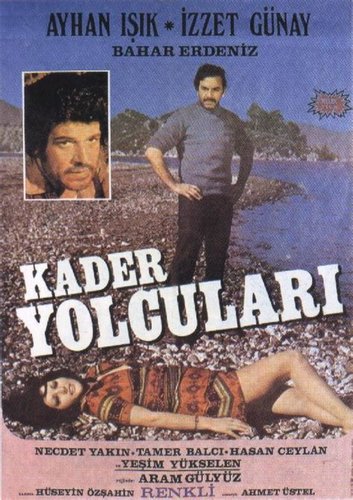
Kader Yolcuları

Travelers of Destiny

Movie · 1975 · 4 people

Kader Yolcuları ("Travelers of Destiny") is a 1975 Turkish-Iranian co-production, a colour emotional drama made in Persian and Turkish. Directed by Orhan Elmas and running 75 minutes, it comes from the Yeşilçam era and carries the Sil Sezer Film name, with Berker İnanoğlu as producer. The film tells the story of a death-row prisoner and a young woman singer.

At its centre is Ruhan, who after years of a wretched life suddenly becomes a famous singer. The man who made that fame possible is Memduh, who deals in shady business and is in love with her without being loved back. He keeps her almost like a prisoner and stops every attempt she makes to escape, until a concert in a prison changes the course of her life. Perihan Savaş plays Ruhan and Bilâl İnci plays Memduh, with Serdar Gökhan as Oruç and Reza Fazeli as Ahmet. The supporting cast includes Renan Fosforoğlu as the prison warden, Seher Şeniz as Sevil, İhsan Baysal as Behçet and Nubar Terziyan as Kadri Baba.

Orhan Kapkı was the director of photography, Gönül Akkor performed the songs and Ekrem Gürkaya designed the credits. Dubbing was done at Acar Film, with voice artists such as Haldun Ergüvenç, Gülen Kıpçak and Abdurrahman Palay voicing members of the cast.

DirectorOrhan Elmas
Production companySil Sezer Film

Reactions

You can pick up to 3 reactions.
Cast

Through different eyes

Yeşilçam Nostalgic A viewer raised on the classics, looking for warm storytelling and strong acting.

With Perihan Savaş as the singer Ruhan and Gönül Akkor's voice on the songs, Kader Yolcuları settles into true Yeşilçam emotional drama. A young woman who rises from misery to fame but loses her freedom, a shady man who loves her without being loved back, and a prison concert that changes her course: this is the kind of material that had audiences of the day reaching for their handkerchiefs. Familiar faces such as Bilâl İnci, Serdar Gökhan and Nubar Terziyan add a homely warmth. A pleasant keepsake for anyone who misses melodramas with songs.

History & Society Lens Asks about the period, the social background and what the work reflects.

This 1975 Turkish-Iranian co-production, made in Persian and Turkish, is an interesting example of the two countries' film ties at the time. Its subject touches a social reality common in the cinema of the period: a young woman who owes her fame to a man and is therefore condemned to his control. Ruhan being kept almost like a prisoner shows plainly the vulnerability of women in show business and the power relations around them. Centring the story on a death-row prisoner and a singer also places two kinds of captivity side by side. It is worth bearing in mind that the language of melodrama ties these issues to emotion rather than probing them deeply.

Cinephile Looks at script, editing and directing choices; keeps a distance from formula films.

Kader Yolcuları sparks historical curiosity as one of Yeşilçam's co-production ventures of the 1970s, and Berker İnanoğlu as producer and the Sil Sezer Film name will ring a bell with anyone who knows the industry of the time. Cinematically, though, the film looks tightly bound to genre formula: the singer who finds fame, the shady patron who holds her captive, a concert that changes fate. A 75-minute running time risks being too short to deepen either the death-row prisoner's story or Ruhan's transformation. Orhan Kapkı's colour cinematography and Gönül Akkor's songs may well be its most appealing elements. How far Turkish dubbing lets a bilingual production hold its performances together is also open to debate.

These are not reader reviews: they are short editorial takes written from different viewer perspectives with AI assistance. Reader reviews are below.

Reviews (0)

Log in Log in to write a review.

Comments