The President

The President (Le Président)

Movie · 1961 · 15 people

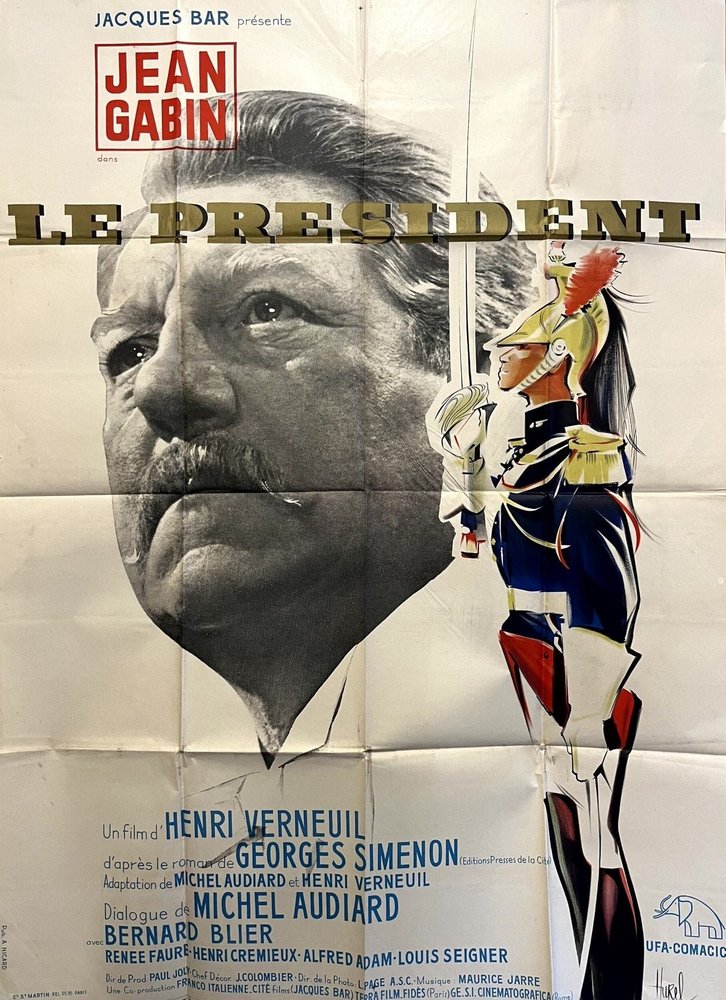
Georges Simenon's novel of the same title, with its ending changed, is the basis of The President (French: Le Président), a French-Italian political drama of 1961 that Henri Verneuil directed and adapted for the screen together with Michel Audiard. Running about 110 minutes, it also leans towards the political thriller and rests largely on dialogue.

The story follows an ageing French prime minister played by Jean Gabin, a statesman who has spent his whole life championing the national good, and who is twice betrayed by an opportunistic younger politician played by Bernard Blier. Besides Gabin and Blier, the cast includes Renée Faure, Louis Seigner, Alfred Adam, Bernard Musson, Héléna Manson and Hans Meyer.

The fictional narrative draws on the political arguments of its day, chiefly monetary devaluation and the quarrel between supporters of a European customs union and sceptics who doubt that the project serves the country's welfare and greatness. The title itself points to an old state term: the French prime minister was formerly called the président du conseil des ministres (chairman of the cabinet), a term later replaced by premier ministre.

DirectorHenri Verneuil

Reactions

You can pick up to 3 reactions.

Cast

Only cast members with a profile on this site are listed.

Henri Crémieux Henri Crémieux Actor · died at 83 Jacques Monod Jacques Monod Film actor · died at 67 Jean Gabin Renée Faure Alfred Adam Albert Simono Amy Collin André Philip Bernard Blier Bernard Musson Christiane Barry Émile Genevois Françoise Deldick Georges Hubert Gisèle Préville
Through different eyes

Cinephile Looks at script, editing and directing choices; keeps a distance from formula films.

Starting from Simenon's novel and changing its ending announces from the outset that the adaptation will look for its own voice. Michel Audiard's involvement fixes the film's centre of gravity: this is a political drama that moves by words rather than events and builds its tension out of sparring lines. The contrast between Jean Gabin's ageing statesman and Bernard Blier's opportunistic younger politician is ideally suited to turning a clash of two generations and two kinds of politics into an acting duel. Its weak side is the risk that a structure resting so heavily on talk sits closer to the stage than to cinema, with the camera easily slipping into the background. Rich for those who love dialogue, static for those after visual storytelling.

History & Society Lens Asks about the period, the social background and what the work reflects.

The film builds a fictional story on real arguments: monetary devaluation, and whether a European customs union would serve the country's welfare. That second debate can be read as an early echo of questions Europe still asks today; the tension between national interest and a common market is nothing new. The title's nod to the old office of chairman of the cabinet also signals the film's ambition to be a portrait of an institution and an era. And the contrast between a statesman devoted to his country and an opportunistic young politician poses a moral question about politics: how do the public good and career calculation share the same table?

Action & Thriller Fan Puts pace, tension and set pieces first; little patience for slow drama.

The political-thriller label sounds exciting, but the weight is on the talking; anyone expecting chases or shootouts may be disappointed. If you want a fast pace, the long dialogue scenes will test your patience. Still, a prime minister betrayed twice and working out his next move can grip like a well-played chess match. A film that asks you to listen closely more than it pins you to your seat.

These are not reader reviews: they are short editorial takes written from different viewer perspectives with AI assistance. Reader reviews are below.

Reviews (0)

Log in Log in to write a review.

Comments