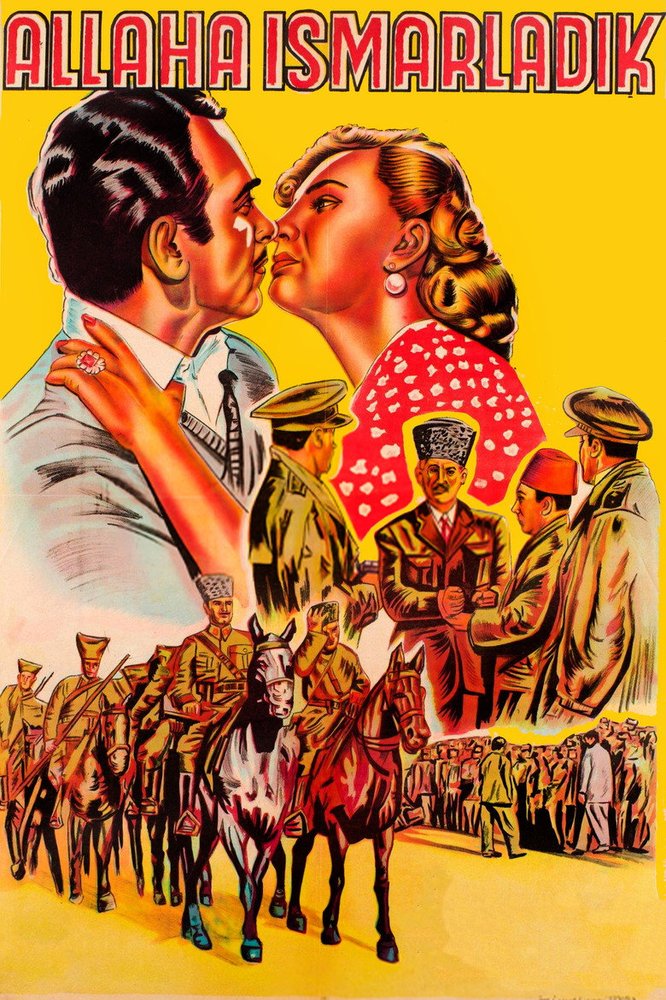
Allaha Ismarladık

Goodbye (Allaha Ismarladık) (translated)

Movie · 1951 · 4 people

Combining history, war, romance and drama, the black-and-white Turkish film Allaha Ismarladık from 1951 belongs to the group of Kuvay-ı Milliye pictures about the War of Independence. Adapted from a work by Esat Mahmut Karakurt, it was also written by its director, Sami Ayanoğlu. Cemil Filmer produced it for Lale Film, and it runs 112 minutes.

The story begins in occupied Istanbul. While smuggling weapons and ammunition to Anatolia, the Kuvay-ı Milliye fighters must deal with both the occupying forces and collaborating Ottoman officials. Right in the middle of this struggle stands the love between Betty (Gülistan Güzey), the occupation commander's daughter, and Captain İzzet, played by Suavi Tedü, a man so committed to his country that he turns even against his collaborator brother-in-law. Refik Kemal Arduman plays General Thomson, Reşit Gürzap the Miralay, and Sadri Alışık, later one of Yeşilçam's beloved actors, Mülazım Tafti.

The cast also includes Samiye Hün, Esen Görkmen, İbrahim Delideniz (Major Nuri), Hadi Hün (Major Celal), Kemal Edige (Captain Henry), Ferhan Tanseli (Captain Ferit), Şükran Güngör (the Interior Minister) and Zeki Alpan. Kriton İlyadis was the cinematographer, Şerif Gürmeriç wrote the music, İzak Dilman edited and Sırrı Gültekin was assistant director.

DirectorSami Ayanoğlu
Production companyLale Film

Reactions

You can pick up to 3 reactions.

Cast

Through different eyes

Yeşilçam Nostalgic A viewer raised on the classics, looking for warm storytelling and strong acting.

This 1951 black-and-white film is one of the early and heartfelt Kuvay-ı Milliye pictures about the years of the War of Independence. Adapted from a work by Esat Mahmut Karakurt, its story melts love of country and a difficult love affair in the same pot. Captain İzzet, resolute enough to turn even against his own brother-in-law, carries the strong moral stance of the old cinema. Seeing Sadri Alışık, later one of Yeşilçam's best-loved faces, as a lieutenant is a special pleasure too. It may feel slow to today's audiences, but its heart is in the right place.

History & Society Lens Asks about the period, the social background and what the work reflects.

In telling of occupied Istanbul and the Kuvay-ı Milliye fighters smuggling arms and ammunition to Anatolia, the film also shows how the War of Independence was remembered in the Republic's early decades. The sharp line between collaborating Ottoman officials and the national struggle reflects a moral order common in the stories of that era. The romance between the occupation commander's daughter and a Turkish officer is an interesting choice that shows how war tests personal ties. Made only about thirty years after the war, the film is also valuable as a document of memory. By today's standards, the characters can seem rather one-dimensional.

Family Viewer Asks whether the whole household can watch it; cares about humour and heart.

A good chance to give children and teenagers who are curious about the War of Independence a love of history. It is a war film, but being from 1951 it is unlikely to be as harsh as today's films. Still, it is black and white and 112 minutes long, so small children may lose patience. Best watched with the grandparents, with breaks to chat along the way.

These are not reader reviews: they are short editorial takes written from different viewer perspectives with AI assistance. Reader reviews are below.

Reviews (0)

Log in Log in to write a review.

Comments