Shoot the Piano Player

Shoot the Piano Player (Tirez sur le pianiste)

Movie · 1960 · 14 people

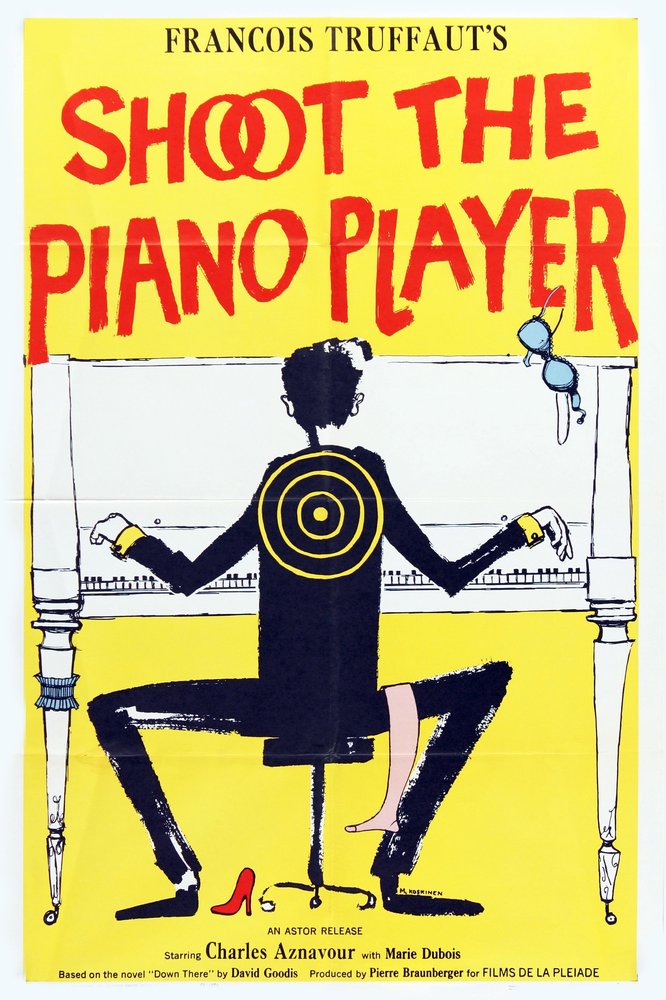
François Truffaut followed his first feature with this 1960 French New Wave crime drama, a black-and-white film produced by Pierre Braunberger: Shoot the Piano Player (French Tirez sur le pianiste; UK title Shoot the Pianist). He and Marcel Moussy adapted it from Down There, the 1956 novel by David Goodis. It blends crime, melodrama and dark comedy, is also described as neo-noir, and appears on the list of 1001 Movies You Must See Before You Die.

Charles Aznavour plays the pianist on the run from his past, Charlie Kohler, whose real name is Edouard Saroyan. He was once a celebrated concert pianist but learns that his career rested on his wife's affair with a talent agent. After her suicide he takes an assumed name and works in a bar, where he grows close to the waitress Léna (Marie Dubois). When his brothers steal the loot of gangsters, Charlie and Léna are targeted for kidnapping. Nicole Berger (Therese Saroyan) and Michèle Mercier (Clarisse) play other women in his life; the cast also includes Albert Rémy, Boby Lapointe, Daniel Boulanger, Alice Sapritch and Laure Paillette.

Georges Delerue composed the music. One viewer calls the film a classic Truffaut and a classic New Wave work, praising Aznavour as the pianist.

DirectorFrançois Truffaut
Production companyPierre Braunberger

Reactions

You can pick up to 3 reactions.

Cast

Only cast members with a profile on this site are listed.

Albert Rémy Actor · died at 55 Laure Paillette Laure Paillette Film actor · died at 71 Charles Aznavour Michèle Mercier Daniel Boulanger Boby Lapointe Marie Dubois Nicole Berger Alice Sapritch Alex Joffé Claude Heymann Claude Mansard Jean-Jacques Aslanian Serge Davri
Through different eyes

Cinephile Looks at script, editing and directing choices; keeps a distance from formula films.

Coming after Truffaut's first feature, this may be the freest example of the New Wave's delight in playing with genres. The script, drawn from David Goodis's novel, runs crime, melodrama and dark comedy all at once; the tone slides from one scene to the next, and that is a deliberate choice. The black-and-white photography and Georges Delerue's music give a unity to a structure that can look loose. Charles Aznavour's shy pianist on the run from his past is the film's emotional centre. Its weakness grows out of its strength: the constant shifts between genres can lose viewers who want a single emotional line. Still, you can see many of modern crime cinema's playful narratives taking root here.

Action & Thriller Fan Puts pace, tension and set pieces first; little patience for slow drama.

Gangsters, stolen loot, a kidnapping threat: there is plenty of crime-film material here. But Truffaut does not build it like a classic thriller; the crime side is mostly tangled up with melodrama and dark comedy. If you expect a tight chase, you may find yourself in a character drama instead. Try it if you enjoy genre rules being broken; if all you want is tension, adjust your expectations.

History & Society Lens Asks about the period, the social background and what the work reflects.

The film tells a quiet story about how fragile an artist's social rise can be. A man who was a celebrated concert pianist learns that his career rested on his wife's affair with an agent, and he changes his name and starts playing in a bar. That descent from the concert hall to the bar hints at a world where success may come from connections rather than talent. The place of the women in his life also carries clues about the period's order of relationships and class. In my view, beneath the crime story, the film can also be read as a social drama about a man who has lost his identity running from his own past.

These are not reader reviews: they are short editorial takes written from different viewer perspectives with AI assistance. Reader reviews are below.

Reviews (0)

Log in Log in to write a review.

Comments