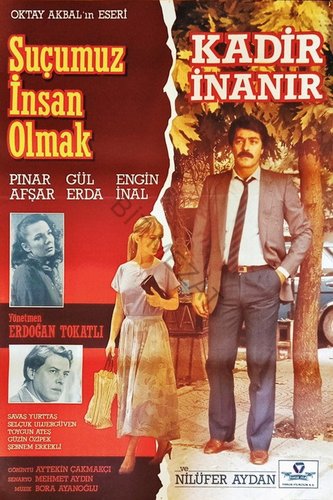
Our Crime Is Being Human (Suçumuz İnsan Olmak)

Our Crime Is Being Human (Suçumuz İnsan Olmak) (translated)

Movie · 1986 · 10 people

Oktay Akbal's novel of the same name, written in 1956, was adapted into Suçumuz İnsan Olmak ("Our Crime Is Being Human"), a 1986 Turkish film. It tells the broken love story of a married civil servant with two children and a young housewife. Before reaching the screen, the novel had been prepared for TRT radio as the radio play series "Arkası Yarın" and drew listeners' attention. The film was shot in color on 35 mm and runs 80 minutes.

At its center is Nuri, a civil servant worn down by his marriage, who grows close to a young, unhappy woman he meets by chance. Their bond is clouded by the age gap between them and by social pressure, and it cannot become a future. Kadir İnanır plays Nuri.

Erdoğan Tokatlı adapted the novel and directed, writing the screenplay with Mehmet Aydın. Varlık Film produced it, with Lokman Kondakçı, Nejat Özbek and Tufan Güner as producers. Shooting took place in Marmaris. Bora Ayanoğlu composed the music and Aytekin Çakmakçı was the cinematographer.

DirectorErdoğan Tokatlı
Production companyVarlık Film

Reactions

You can pick up to 3 reactions.

Cast

Also in the cast: Şebnem Gürsoy, Beyhan Akbaşlı, Ümit Yesin, Şebnem Erkekli

Through different eyes

Yeşilçam Nostalgic A viewer raised on the classics, looking for warm storytelling and strong acting.

Before it reached the screen, Oktay Akbal's novel had found listeners through TRT radio's "Arkası Yarın" serial; for an ear devoted to that radio-drama tradition, this film means a beloved story finally given images. The doomed love between a married civil servant and an unhappy young woman draws on one of Yeşilçam's oldest themes, and the weary Nuri that Kadir İnanır plays sits close to the classic figure of the man who keeps his sorrow to himself. Yet the mid-eighties were years when the old melodrama idiom was starting to tire, so it is fair to ask whether the film's warmth comes from its literary source or from its own filmmaking.

History & Society Lens Asks about the period, the social background and what the work reflects.

Starting from a novel, the film traces a triangle of civil-service life, marriage and social pressure. That the bond between a married civil servant with two children and an unhappy young housewife cannot become a future speaks less of private heartbreak than of the weight of the era's notions of family and honor. The age gap and the pressure of those around them shrink the space in which these people can decide about their own lives. The word crime in the title says it outright: what stands judged is human feeling itself. And the thirty-year gap between the novel and the film quietly raises the question of how little that pressure had changed in the meantime.

Cinephile Looks at script, editing and directing choices; keeps a distance from formula films.

Bringing a novel's inner world to the screen is never easy; the screenplay Erdoğan Tokatlı wrote with Mehmet Aydın has to lean heavily on atmosphere and performance to turn two lonely people drawing closer into images. Shooting in Marmaris gives a story of marital suffocation an unusual backdrop, and Aytekin Çakmakçı's photography and Bora Ayanoğlu's score are well placed to carry that contrast. The weak link is the genre mix: carrying the labels of drama, romance and adventure at once risks scattering the film's tone. In a compact running time, a literary inner world also struggles to deepen, and the result can feel like an emotional digest of its source rather than a full melodrama.

These are not reader reviews: they are short editorial takes written from different viewer perspectives with AI assistance. Reader reviews are below.

Reviews (0)

Log in Log in to write a review.

Comments