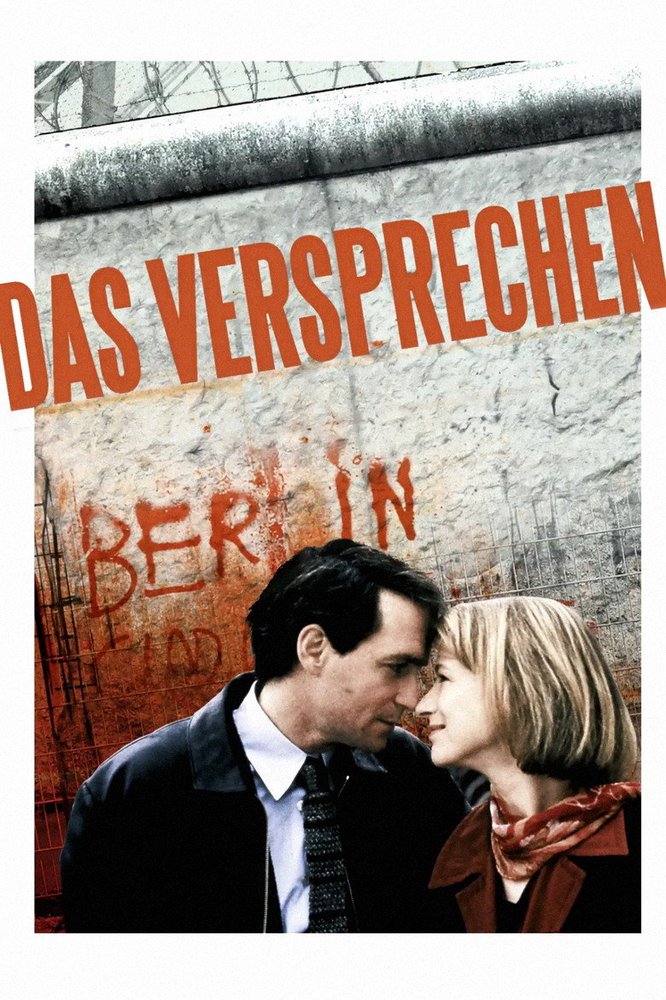
The Promise

The Promise (Das Versprechen)

Movie · 1994 · 15 people

Margarethe von Trotta made the German-language melodrama The Promise as a joint production of Germany, France and Switzerland; its German title is Das Versprechen, and in France it was called Les Années du mur. Through a love story, it traces how East and West Germany failed each other. It opened in Germany in 1994 and in France in 1995; the screenplay is credited to Peter Schneider, Felice Laudadio and von Trotta.

The story begins in Berlin in 1961, on a misty day. Sophie and her lover Konrad plan to flee the city together, but the attempt falls through and they are parted: Konrad starts a life in the East, Sophie in the West. Close yet far apart in the same city, the couple spend the years waiting to meet again. Meret Becker plays the younger Sophie and Corinna Harfouch the older; Anian Zollner is the younger Konrad and August Zirner the older. Eva Mattes and Dieter Mann also appear.

Von Trotta won the Bavarian Film Award for Best Director for the film. It was chosen as Germany's official entry for Best Foreign Language Film at the 67th Academy Awards but was not nominated. Eberhard Junkersdorf produced and Jürgen Knieper wrote the music. Known in Turkey as Bekleyiş, it screened at the Istanbul Film Festival.

DirectorMargarethe von Trotta
Production companyBioskop Film

Reactions

You can pick up to 3 reactions.

Cast

Only cast members with a profile on this site are listed.

Corinna Harfouch Corinna Harfouch Actor · 72 years old Philippe Morier-Genoud Philippe Morier-Genoud Actor · 82 years old Meret Becker Anian Zollner August Zirner Eva Mattes Pierre Besson Hans Kremer Dieter Mann Simone von Zglinicki Ruth Glöss Jean-Yves Gautier Ulrike Krumbiegel Tina Engel Monika Hansen

Through different eyes

Cinephile Looks at script, editing and directing choices; keeps a distance from formula films.

Von Trotta tells the story of a divided Berlin not through grand political set pieces but through a couple's separated lives, and that choice is both the film's strength and its limit. Casting different actors for the characters' younger and older selves is a bold way of putting the weight of the years on their faces, though the shift between the two periods risks loosening the viewer's bond with them. The melodrama frame fits political history into an emotional shape, but at times it tips into sentiment that is a little too insistent. Still, her Best Director prize at the Bavarian Film Awards suggests the restraint in the staging did not go unnoticed. A film that uses the Wall not as scenery but as a measure of time, and one that rewards patience.

History & Society Lens Asks about the period, the social background and what the work reflects.

Starting in 1961, the film reads the rift between East and West Germany through two people's years spent apart. Its value lies in inviting us to think of the Cold War as a story of ordinary lives rather than of states. People forced to live under entirely different systems on two sides of the same city pose a question familiar to any society that knows divided families and separation. That a German-language film reached festival audiences in Turkey under the title Bekleyiş, The Waiting, suggests this feeling of waiting is understood well beyond borders.

Family Viewer Asks whether the whole household can watch it; cares about humour and heart.

This is not one for young children: the subject is heavy and the emotions are grown-up. It can work, though, with high-school teenagers who are learning about the Berlin Wall in history class. A couple's long wait after being parted is a good way to talk plainly at home about what separation does to people. Little ones will probably get bored; older viewers may well find something of themselves in it.

These are not reader reviews: they are short editorial takes written from different viewer perspectives with AI assistance. Reader reviews are below.

Reviews (0)

Log in Log in to write a review.

Comments