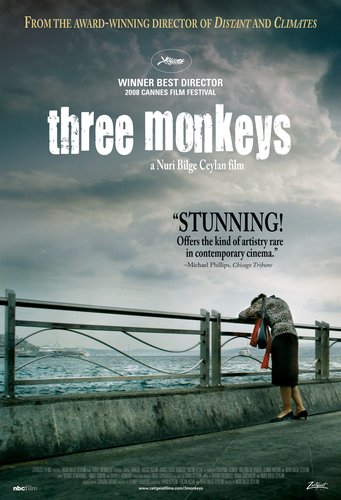
Three Monkeys (Üç Maymun)

Three Monkeys (Üç Maymun)

Movie · 2008 · 4 people

Üç Maymun (Three Monkeys) is a 2008 drama about a family falling apart as small weaknesses grow into great lies. Nuri Bilge Ceylan directed this Turkish-French-Italian co-production. It was his fifth feature and, after Uzak and İklimler, his third in Cannes competition, where at the 61st festival it won him the Best Director award. As Turkey's 81st Academy Awards entry it made the January shortlist of nine but was not nominated. It opened in Turkey on October 24, 2008.

The title points to escaping pain and responsibility by not seeing, hearing or speaking of the truth. Servet, a businessman about to stand as an opposition candidate, causes a fatal accident on a lonely road. He asks his driver Eyüp, who was not even in the car, to take the blame for money, and Eyüp goes to prison. Servet's affair with Eyüp's wife Hacer and the anger of their son İsmail push the family toward another crime. Yavuz Bingöl, Hatice Aslan, Ahmet Rıfat Şungar and Ercan Kesal lead the cast.

Ceylan co-wrote the script with his wife Ebru and the actor Ercan Kesal. On the Turkish film site Beyazperde, Ali Ercivan singled out its visual language and a stronger dramatic structure than in his earlier films.

DirectorNuri Bilge Ceylan
Production companyZeyno Film, Pyramide Productions, NBC Film, BiM Distribuzione

Reactions

You can pick up to 3 reactions.

Cast

Through different eyes

AI-assisted editorial takes written from different viewer perspectives. They are not reader reviews; those are below.

Cinephile Looks at script, editing and directing choices; keeps a distance from formula films.

Three Monkeys keeps Nuri Bilge Ceylan's observational calm but gives it a much tighter dramatic frame than his earlier films. The knot of a driver taking the blame for someone else's crime in exchange for money is the stuff of classic moral drama, yet Ceylan leans on images and restrained acting rather than dialogue. You can feel the photographer's eye in almost every shot. Yavuz Bingöl and Hatice Aslan carry the film with performances built on what goes unsaid, so the Best Director prize at Cannes is no surprise. The rhythm is set for viewers who know how to wait; some pauses seem to serve style more than meaning, and it helps to know going in that patience is required.

History & Society Lens Asks about the period, the social background and what the work reflects.

Starting from a businessman preparing for an election who pays to shift the blame for a fatal accident onto a poor family, the film asks a hard question about class: how does the mistake of the powerful become the punishment of the powerless? Eyüp's prison term, Servet's affair with Hacer and İsmail's anger suggest that the see-no-evil attitude behind the title belongs not just to one family but to a wider social habit. Ceylan shows this without preaching, from inside everyday life. Its portrait of a family caught between money, reputation and silence is a quiet but forceful witness to its time.

Action & Thriller Fan Puts pace, tension and set pieces first; little patience for slow drama.

The opening accident and the deal to take the blame are a great spark for tension, and the family slowly edges toward another crime. But the film chooses to tell it slowly, through long waits. Don't look for speed and movement. The tension is there, it just builds in silence; the shadow of the opening accident hangs over the whole film.

Reviews (0)

Log in Log in to write a review.

Comments