Far (Uzak)

Far (Uzak) (translated)

Movie · 2002 · 7 people

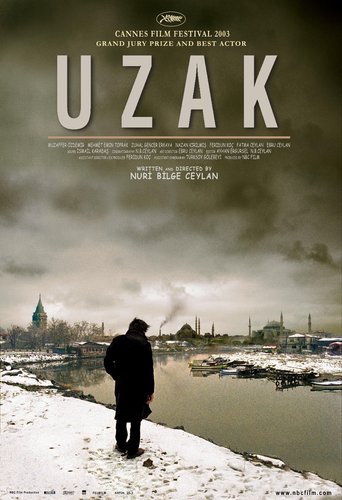
Uzak is Nuri Bilge Ceylan's 2002 drama, a quiet, slow-paced film that he also wrote, produced and shot. Cemil Kavukçu co-wrote it. It completes the trilogy that began with Kasaba and continued with Mayıs Sıkıntısı. It opened in Turkey on December 20, 2002.

Set in snowy Istanbul, the story pairs Mahmut, a photographer who loses his sense of purpose as he drifts from his ideals, played by Muzaffer Özdemir, with Yusuf (Mehmet Emin Toprak). Yusuf, a young man from Mahmut's hometown, arrives after losing his factory job and dreams of finding work on a ship. The strain between the two men sharing a home becomes the subject: how a man's standing depends on career success, and how little he can say about his worries.

At Cannes in 2003 the film took the Grand Prix, and Özdemir and Toprak shared the Best Actor prize. Toprak died on December 2, 2002, in a road accident near Çan, aged 28; this was his last role. It also won Best Film, Best Director and Best Screenplay at the 39th Golden Orange. Turkey submitted it for the Academy Award for Best Foreign Language Film, but it was not nominated.

DirectorNuri Bilge Ceylan
Production companyNBC Ajans

Reactions

You can pick up to 3 reactions.

Cast

Through different eyes

AI-assisted editorial takes written from different viewer perspectives. They are not reader reviews; those are below.

Cinephile Looks at script, editing and directing choices; keeps a distance from formula films.

Written, directed, produced and shot by Nuri Bilge Ceylan himself, Uzak feels like the most mature part of the trilogy that began with Kasaba. The snowy Istanbul winter is not just a backdrop but the visual equivalent of two men failing to communicate. Little dialogue, much silence: the slow rhythm chooses to show the tension between Mahmut and Yusuf rather than spell it out. Muzaffer Özdemir and Mehmet Emin Toprak sharing Best Actor at Cannes is no accident; both play men who cannot voice their troubles with the barest of means. The Grand Prix at Cannes and Best Film, Director and Screenplay at the Golden Orange reward that rigor. That this was Toprak's last role adds a sorrow of its own.

History & Society Lens Asks about the period, the social background and what the work reflects.

Uzak puts a young man who has lost his job and come to the city from his hometown under the same roof as a settled urban photographer who has drifted from his ideals, drawing a quiet portrait of migration and class. Yusuf, laid off from the factory, dreams of finding work on a ship and sailing far away, which reflects how pressing worries about work and the future could be for young men of the time. The film shows, without exaggeration, how much a man's social standing depends on success at work, and how hard it is for these men to put their feelings into words. The distance between Mahmut and Yusuf also traces the invisible line between city dweller and provincial. A piece of social observation that never lectures, yet lingers long after it ends.

Action & Thriller Fan Puts pace, tension and set pieces first; little patience for slow drama.

Uzak is not my kind of film. Barely anything happens, the dialogue is sparse and the pace is very slow. It makes you feel the tension between two men sharing a flat, but it does so through silence and asks for patience from start to finish. I get why it won its awards, and snowy Istanbul looks striking; save this one for an evening when you are not craving tension or movement.

Reviews (0)

Log in Log in to write a review.

Comments