Young Sinners

Young Sinners (Les Tricheurs)

Movie · 1958 · 15 people

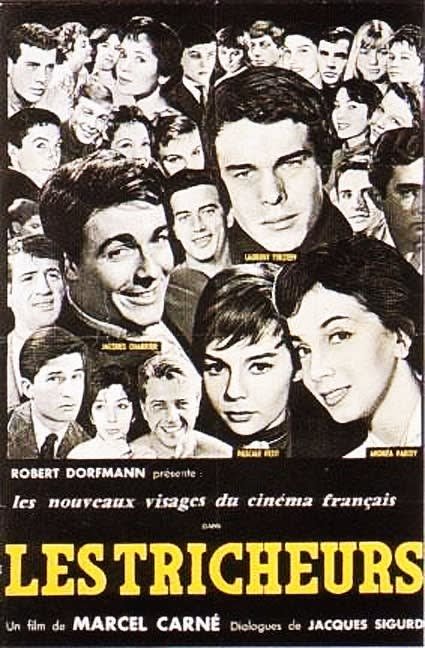
Mixing comedy with drama, Marcel Carné's 1958 film Young Sinners paints the manners and spirit of the young people of its day; Carné wrote the screenplay himself. The French-Italian production, titled Les Tricheurs in the original and Peccatori in blue-jeans in Italy, runs about 121 minutes.

The film follows the daily lives of a group of fairly well-off young Parisians at the end of the 1950s. They drift between the Left Bank around Saint-Germain-des-Prés and the Right Bank of the 16th arrondissement. Carné made it after he had turned fifty, yet through its subject the film anticipates the New Wave. Pascale Petit and Jean-Paul Belmondo star, and the cast also includes Jacques Charrier, Laurent Terzieff, Pierre Brice, Dany Saval, Claude Giraud and Andréa Parisy. Of these young performers, Belmondo and Pierre Brice would become big stars in the following decade. Belmondo appears here in one of his earliest roles.

The film was a huge box-office success, selling nearly five million tickets in France, and in Italy it drew more than five million viewers in the 1958-1959 season. It received the Grand prix du cinéma français in the year of its release.

DirectorMarcel Carné

Reactions

You can pick up to 3 reactions.

Cast

Only cast members with a profile on this site are listed.

Pascale Petit Pascale Petit Actor · 88 years old Jean-Paul Belmondo Jean-Paul Belmondo Film actor · died at 88 Jacques Charrier Laurent Terzieff Alain Janey Alain Saury Alan Scott Andréa Parisy Andrée Servilange Andrée Tainsy Anne-Marie Coffinet Arielle Coigney Claire Olivier Claude Giraud Dany Saval

Through different eyes

Cinephile Looks at script, editing and directing choices; keeps a distance from formula films.

Made after Carné had turned fifty, this film is an interesting threshold work for the way its subject anticipates the New Wave. But there is a tension here: the subject is young while the gaze is that of a classic French master. Carné writing the script himself may have produced a tone that looks at young people's moods from outside; next to the looser, insider storytelling of the New Wave, the film may seem tidier and more constructed. On the other hand, seeing Belmondo in one of his earliest roles is reason enough for anyone curious about film history. Mixing comedy with drama also keeps the youth of the day from being locked into a single tone.

History & Society Lens Asks about the period, the social background and what the work reflects.

The film follows fairly well-off young Parisians at the end of the 1950s as they drift between the Left Bank around Saint-Germain-des-Prés and the Right Bank of the 16th arrondissement, two poles standing for different faces of the same generation. Selling nearly five million tickets in France and reaching more than five million viewers in Italy shows it caught a real curiosity about the youth of its day. Its focus on the attitudes of a generation growing up in the post-war years can be read as an early sign of the changes of the following decade. Still, concentrating only on a well-off slice of society keeps its picture limited.

Family Viewer Asks whether the whole household can watch it; cares about humour and heart.

A youth drama about the daily lives and attitudes of young people of its time, aimed more at adults. There are comic moments, but the subject is not the kind that grabs children, and the film is fairly long. It suits older teenagers or parents curious about film history; small children will most likely get bored.

These are not reader reviews: they are short editorial takes written from different viewer perspectives with AI assistance. Reader reviews are below.

Reviews (0)

Log in Log in to write a review.

Comments