Arabesque (Arabesk)

Arabesque (Arabesk) (translated)

Movie · 1989 · 9 people

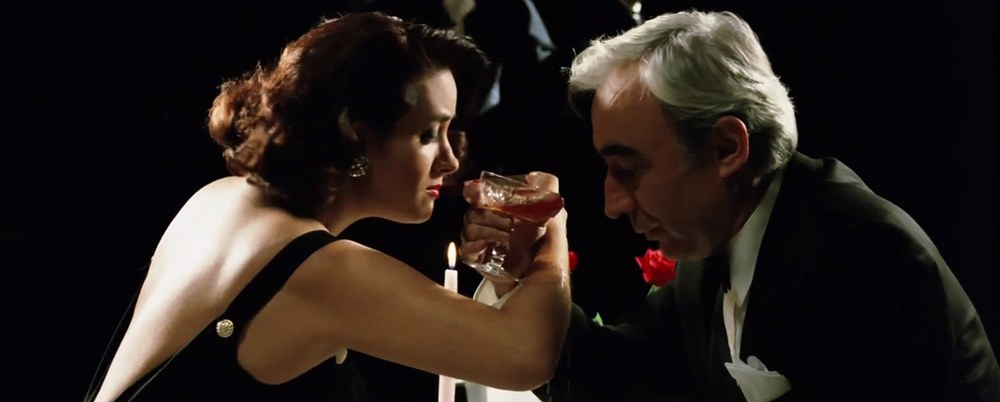
Ertem Eğilmez directed Arabesk, a Turkish comedy from 1988 with a screenplay by Gani Müjde, released February 1989. An absurdist comedy, it was the last work of Eğilmez, a leading Turkish director. He finished it from his sickbed, watching footage brought to his room, and died three months after seeing the edited cut. Mocking the arabesque craze of the day and Yeşilçam's pseudo-intellectuals, it stirred controversy in Turkey and counts among the earliest absurdist Turkish films.

It is the story of two lovers who cannot be united. Müjde (Müjde Ar), a village landlord's daughter, and Şener (Şener Şen) have loved each other since childhood, but her father opposes the match and parts them with a trick. Unaware of each other's move, both go to Istanbul, where each crosses paths with the King of the Nightclubs. Kaya (Necati Bilgiç), who has dogged them since childhood, obstructs them every time, and the King's passion for Müjde makes things worse. He later repents and helps the pair marry; Uğur Yücel is in the cast as Ekrem.

Üstün Asutay plays Müjde's father, with Rasim Öztekin, Kadir Savun and Candan Sabuncu also appearing. Music is by Aysel Gürel and cinematography by Aytekin Çakmakçı; producers are Türker İnanoğlu and Nahit Ataman, for Arzu Film and Erler Film.

DirectorErtem Eğilmez
Production companyArzu Film
Arabesque (Arabesk)

Reactions

You can pick up to 3 reactions.

Cast

Also in the cast: Üstün Asutay (Müjde's father), Necati Bilgiç (Kaya)

Through different eyes

Yeşilçam Nostalgic A viewer raised on the classics, looking for warm storytelling and strong acting.

Being Ertem Eğilmez's last film gives Arabesk a meaning that tugs at the heart as you watch. Şener Şen and Müjde Ar's star-crossed lovers knowingly exaggerate every convention of the arabesque film, and seeing Münir Özkul in the cast is, as always, a gift. Still, it must be admitted: for an eye used to Eğilmez's warm, humane comedies, the absurd humor gets too loud at times. Feeling is often buried under the parody. The music by Aysel Gürel is the sweetest thing about it.

History & Society Lens Asks about the period, the social background and what the work reflects.

Arabesk is a satire aimed at the arabesque craze that dominated the cinema of its day and at Yeşilçam's pseudo-intellectuals. A village landlord's daughter and her childhood sweetheart each heading to Istanbul unaware of the other and falling into the nightclub world turns the familiar arabesque template inside out: migration from village to city, love that can never be fulfilled, and nightlife. The controversy it stirred in Turkey hints at how sensitive a matter of identity that culture had become by then. Seen today, it is a fascinating record of how a wave of popular culture could be mocked in its own time.

Family Viewer Asks whether the whole household can watch it; cares about humor and heart.

Arabesk is an over-the-top, absurd comedy. Şener Şen and Müjde Ar's doomed love story is funny and sometimes surprising. But most of the jokes land for grown-ups who know the arabesque films of those years; young children may not get the parody. The nightclub setting is also a big part of the story. So it suits adults and teenagers better.

These are not reader reviews: they are short editorial takes written from different viewer perspectives with AI assistance. Reader reviews are below.

Reviews (0)

Log in Log in to write a review.

Comments