Çözülmeler

Dissolutions (Çözülmeler) (translated)

Movie · 1994 · 3 people

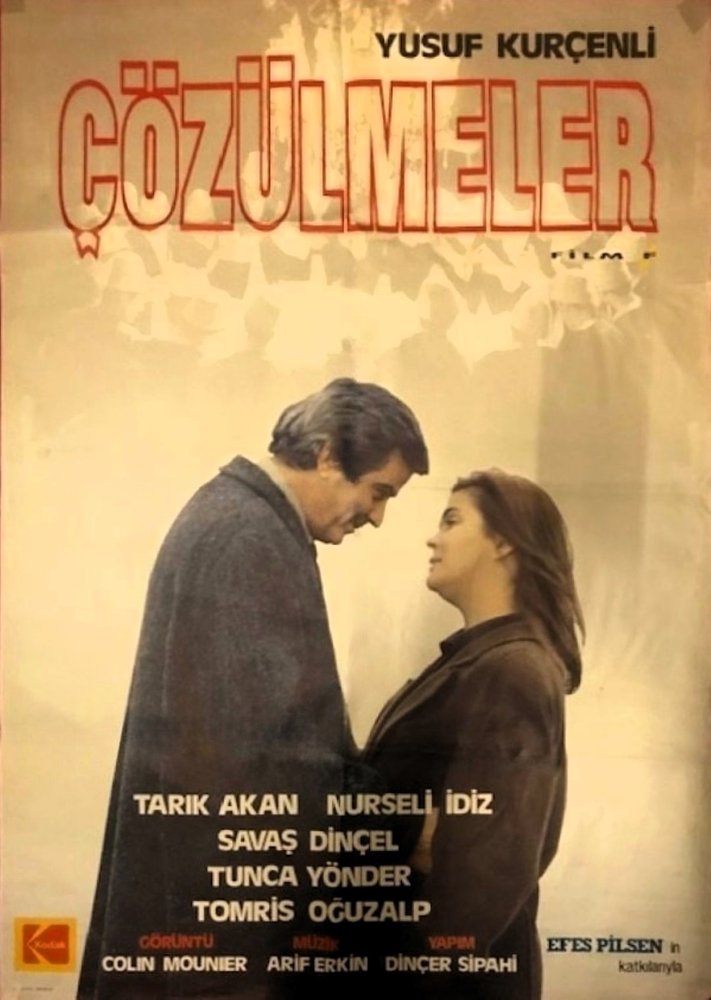
The Turkish drama Çözülmeler ("Dissolutions") came out on 6 May 1994. It looks at the inner lives of people who lived through the coups of 12 March and 12 September and tells, at the scale of one story, the damage such upheavals leave on conscience and love. It was shot on 35 mm colour film and runs about 100 minutes.

At its centre is Uğur, an accountant played by Tarık Akan. He cannot adapt to the new social values that rose after the coups, and he carries a heavy guilt: he drew his younger brother into political struggle, and the brother was executed. Uğur writes a novel about this reckoning, and then meets Nihal, an acquaintance from his pre-12 September circle. Nihal, played by Nurseli İdiz, lives with her husband's parents while her husband is in prison for a political offence. Their troubles mirror each other, so an innocent solidarity grows into a passionate love. But social pressure builds, the husband's release nears, and the two are pushed down a road with no return.

Director Yusuf Kurçenli wrote the screenplay with Cezmi Ersöz and shared the producing with Dinçer Sipahi. The music is by Cem İdiz, the cinematography by Colin Mounier, with editing by İsmail Kalkan.

DirectorYusuf Kurçenli

Reactions

You can pick up to 3 reactions.

Cast

Through different eyes

History & Society Lens Asks about the period, the social background and what the work reflects.

Çözülmeler is a serious drama that looks into the inner lives of a generation that lived through the coups of 12 March and 12 September. The guilt carried by Uğur, an accountant whose younger brother he drew into political struggle was executed, gives concrete shape to the wounds the coups left on individual consciences. Nihal, living with her husband's parents while he is in prison for a political offence, makes visible the silent burden those years placed on women. In portraying people who cannot adapt to the new values that rose after the coups, the film also records a period of social change. Its picture of how social pressure closes in on two people's relationship makes this 1994 film one of cinema's important witnesses to Turkey's recent history.

Cinephile Looks at script, editing and directing choices; keeps a distance from formula films.

Yusuf Kurçenli chose to scale great political ruptures down to a single story, and that choice gives the film an intense sincerity. The script, written with Cezmi Ersöz, makes Uğur's guilt and the novel in which he works through it the backbone of the narrative, and the relationship with Nihal is carefully woven from two characters whose troubles mirror each other. The chemistry between Tarık Akan and Nurseli İdiz makes the shift from innocent solidarity to passionate love believable. Colin Mounier's cinematography and Cem İdiz's music support the film's melancholy atmosphere. On the other hand, the narrative sometimes grows heavy and leans too much on inner reflection, a pace that may test viewers who are not drawn to the political cinema of the period. Still, a personal and courageous work.

Family Viewer Asks whether the whole household can watch it; cares about humour and heart.

A film for adults, with a heavy subject. It deals with coups, an executed brother, guilt and a passionate love affair with a woman whose husband is in prison. It is not suitable for children, and even teenagers may struggle to grasp the subject. For adults curious about recent history, it is a thought-provoking and emotional film. Anyone looking for a light family evening should choose something else.

These are not reader reviews: they are short editorial takes written from different viewer perspectives with AI assistance. Reader reviews are below.

Reviews (0)

Log in Log in to write a review.

Comments