Günahsızlar

The Innocent (Günahsızlar) (translated)

Movie · 1972 · 3 people

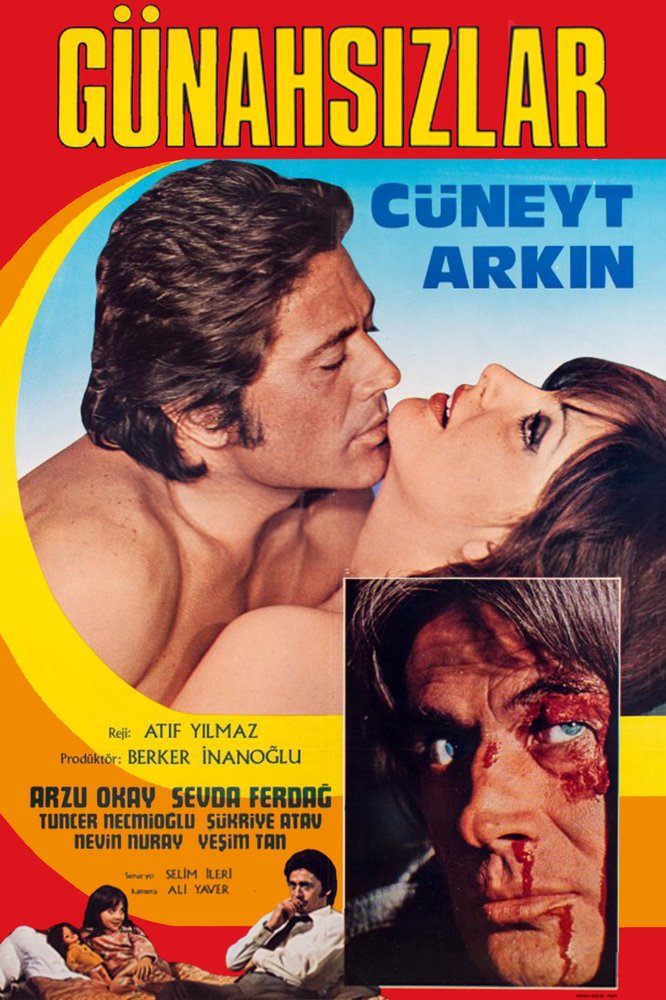
Selim İleri's screenplay became Günahsızlar ("The Innocent"), a Turkish drama that Atıf Yılmaz directed in 1972. It follows a young man whose life is overturned by a killing and who must then live with his conscience. The 73-minute colour production opened on 1 December 1972; it was made by Er Film and Erbil Film and produced by Berker İnanoğlu.

Kemal is a successful architect whose world is shaken when he learns that his lover has been seeing Ökkeş, a nightclub owner. Ökkeş's men beat him almost to death, and Kemal takes his revenge by killing Ökkeş. The court acquits him, yet that does nothing to ease his guilt, and he takes in Ökkeş's little daughter, left with no one. Even so, the crime he committed in the past will not let him go. Cüneyt Arkın plays Kemal, Sevda Ferdağ plays Gönül and Tuncer Necmioğlu plays Ökkeş. Arzu Okay appears as Ayşe, Nevin Nuray as Gülçin and Yeşim Tan as Melek, with Nuri Tuğ, Haydar Karaer and Muammer Gözalan also in the cast.

Ali Yaver was the cinematographer, and colour processing and sound work were handled at Acar Film. As was usual then, Cüneyt Arkın was dubbed by Toron Karacaoğlu. The film brings together murder, a courtroom, remorse, the nightclub world and eroticism.

DirectorAtıf Yılmaz
Production companyEr Film, Erbil Film

Reactions

You can pick up to 3 reactions.

Cast

Through different eyes

Cinephile Looks at script, editing and directing choices; keeps a distance from formula films.

The pairing of Atıf Yılmaz and Selim İleri sets this film apart from the routine nightclub dramas of its day. The script's centre of gravity is not the killing itself but the guilt that persists even after the acquittal, an inwardness rarely found in Yeşilçam's commercial dramas. Yet 73 minutes are not enough to deepen this psychological material: betrayal, the beating, revenge and the trial rush by, while the reckoning with conscience gets less room than it deserves. Cüneyt Arkın, voiced by Toron Karacaoğlu, convincingly plays a man turning in on himself. The erotic elements add little to the film's seriousness and break its tone. Still, it is a stop in Atıf Yılmaz's filmography that deserves attention.

Yeşilçam Nostalgic A viewer raised on the classics, looking for warm storytelling and strong acting.

Seeing Cüneyt Arkın as an architect tormented by his conscience is a fine opportunity for those who love his dramatic side. Selim İleri's pen gives the story literary depth; the guilt gnawing at a man the court has acquitted is a moral theme the old Turkish dramas loved. Kemal taking in the little girl left fatherless gives the film a tender heart. The roughness of the nightclub world and the erotic scenes, however, may feel too harsh to an eye looking for a warm story.

History & Society Lens Asks about the period, the social background and what the work reflects.

Through the clash between a successful architect and a nightclub owner, the film sets two faces of early-1970s city life against each other: respectable professions and the harsh world of nightlife. The court acquitting Kemal opens up the gap between legal justice and the justice of conscience; the film looks at the space between being cleared by the law and being unable to clear oneself. Kemal taking in the little daughter of the man he killed brings responsibility and atonement to the fore. Selim İleri's script places these questions inside the character's inner world rather than spelling them out.

These are not reader reviews: they are short editorial takes written from different viewer perspectives with AI assistance. Reader reviews are below.

Reviews (0)

Log in Log in to write a review.

Comments