Les Misérables

Les Misérables

Movie · 1958 · 15 people

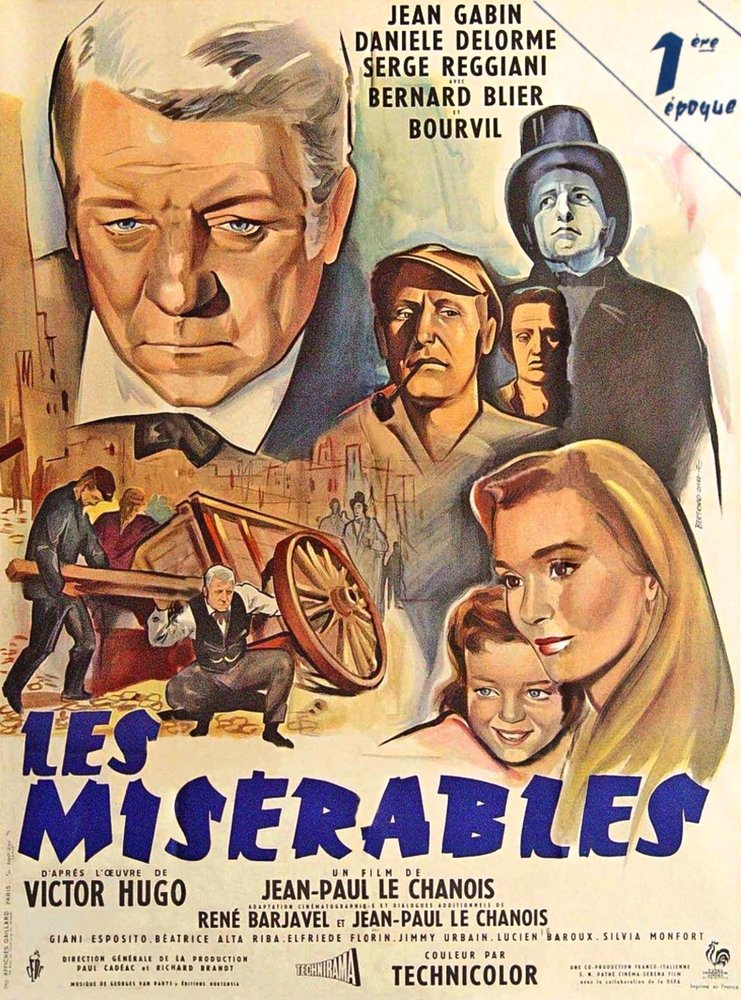
Les Misérables is the 1958 screen adaptation of Victor Hugo's celebrated 1862 novel. A French-Italian-East German co-production made by Pathé together with the East German DEFA studio, it is a two-part drama of about 210 minutes. It is one of only four film co-productions between France and East Germany. It opened in France on 12 March 1958 and in East Germany on 16 and 23 January 1959.

The film tells Hugo's story across two parts. Jean Gabin plays the former convict Jean Valjean, and Bernard Blier is Inspector Javert, who pursues him without mercy. The cast also includes Bourvil, Danièle Delorme, Béatrice Altariba, Giani Esposito and Silvia Monfort.

Jean-Paul Le Chanois directed, from a screenplay by Michel Audiard, René Barjavel and Le Chanois himself. Filming ran from 1 April to 25 October 1957. Most of it took place over eight weeks at the DEFA studio in Potsdam-Babelsberg, where early nineteenth-century Paris streets were rebuilt from the novel's descriptions; the Francœur studio in Paris was also used. More than 7.8 million people saw it in France, making it the most popular film of 1958, and critics often call it the most memorable screen version of the novel.

DirectorJean-Paul Le Chanois
Production companyPathé

Reactions

You can pick up to 3 reactions.

Cast

Only cast members with a profile on this site are listed.

Laure Paillette Laure Paillette Film actor · died at 71 Luc Andrieux Luc Andrieux Actor · died at 60 Jean Gabin Bernard Blier Bourvil Danièle Delorme Béatrice Altariba Giani Esposito Silvia Monfort Allain Dhurtal André Dalibert Bernard Musson Christian Brocard Christian Fourcade Christian Lude

Through different eyes

Yeşilçam Nostalgic A viewer raised on the classics, looking for warm storytelling and strong acting.

This is an old-school adaptation that approaches Victor Hugo's great novel seriously and without haste. Spread over two parts, it gives its characters room to breathe, unlike today's fast-cut versions, and the clash between mercy and rigid justice is felt in full weight in the encounters between Jean Valjean and the relentless Javert. I think critics are right to call it the most memorable screen version of the novel. Its 7.8 million-plus admissions in France, making it the most popular film of 1958, also recall an era when great literature could reach a mass audience.

History & Society Lens Asks about the period, the social background and what the work reflects.

What happened behind the camera is as interesting as the story itself. Being one of only four film co-productions between France and East Germany shows that, in the middle of the Cold War, Hugo's novel of poverty, justice and mercy could serve as common ground for two different systems. In my view it is no accident that Pathé and DEFA met over this novel: a story built on class and misery could speak to both sides in their own language. Rebuilding early nineteenth-century Paris streets at Potsdam-Babelsberg from the novel's descriptions can also be read as an attempt to reconstruct a period's city through literature.

Family Viewer Asks whether the whole household can watch it; cares about humour and heart.

Hugo's story says valuable things for families: mercy, honesty and giving people a second chance. But this is a 210-minute film in two parts, hard to finish in one sitting. Splitting it over two evenings is best. There are heavy themes such as poverty, prison and a merciless pursuit, so it may be too long and gloomy for young children. Middle and high school students reading the novel, on the other hand, will get a lot out of it.

These are not reader reviews: they are short editorial takes written from different viewer perspectives with AI assistance. Reader reviews are below.

Reviews (0)

Log in Log in to write a review.

Comments