Madame Sans-Gêne

Madame Sans-Gêne

Movie · 1961 · 15 people

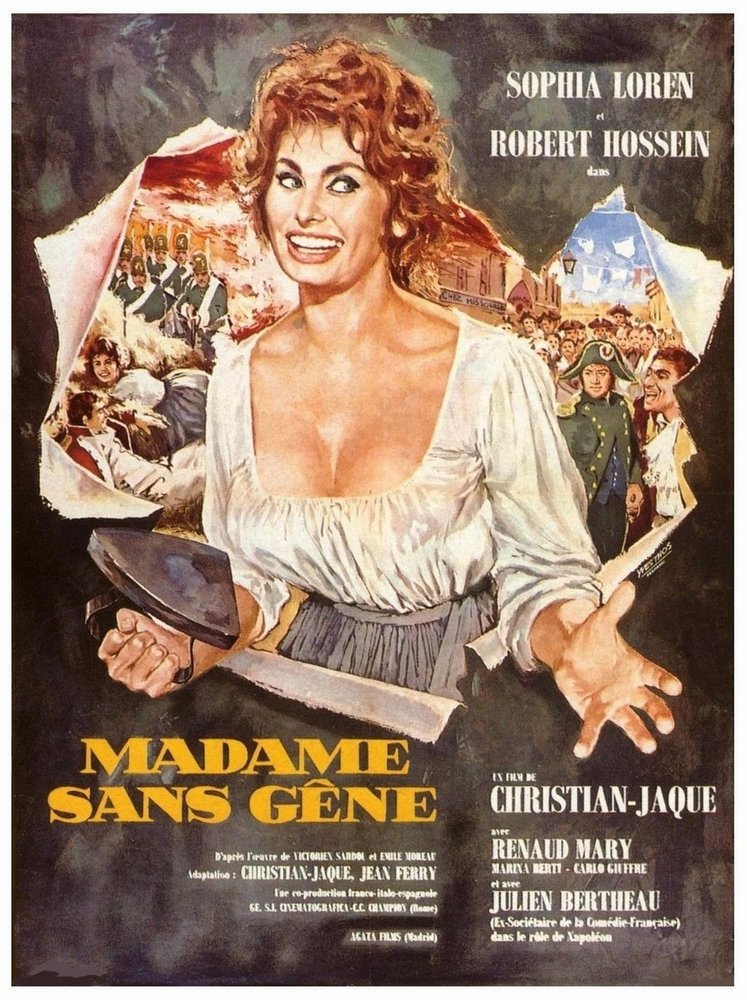
Madame, properly Madame Sans-Gêne, is a 1961 French-Italian-Spanish co-production directed by Christian-Jaque. It sits between romantic comedy and comedy-drama, and is also described as a comedy of manners. It adapts the 1893 play of the same name by the French dramatists Victorien Sardou and Émile Moreau. Shot in Eastmancolor and Technirama, it runs 108 minutes and was distributed in the United States by Embassy Pictures.

Sophia Loren heads the cast, joined by Robert Hossein, Julien Bertheau, Renaud Mary, Léa Gray, Gianrico Tedeschi, Marina Berti, Analía Gadé, Laura Valenzuela, Carlo Giuffré, Fernando Sancho, Gabriella Pallotta, Robert Dalban and Ida Galli. The screenplay was written by the director himself with Ennio de Concini and Jean Ferry.

The play's screen career did not begin with this film. The Sardou-Moreau work was hugely popular on stage and inspired a novel by Raymond Lepelletier. It became a silent film with Gloria Swanson in the 1920s, and Umberto Giordano turned the same tale into an opera, Madame Sans-Gêne, which premiered at the Metropolitan Opera House in 1915. In Germany the film is known as Ungezähmte Catherine.

DirectorChristian-Jaque

Reactions

You can pick up to 3 reactions.

Cast

Only cast members with a profile on this site are listed.

Robert Dalban Robert Dalban Actor · died at 83 Ida Galli Ida Galli Film actor · born 1939 Sophia Loren Robert Hossein Gianrico Tedeschi Marina Berti Carlo Giuffrè Julien Bertheau Renaud Mary Fernando Sancho Jean Berger Renato Terra Inge Meysel Gabriella Pallotta Karl John
Through different eyes

Cinephile Looks at script, editing and directing choices; keeps a distance from formula films.

The Sardou-Moreau play is material already tried on stage, in silent cinema and in opera, so the real question for this adaptation is whether it has anything new to say. Christian-Jaque, who wrote the screenplay with Ennio de Concini and Jean Ferry, seems to have pinned his answer largely on the visuals: Eastmancolor and Technirama are well suited to turning a comedy of manners into a wide spectacle. But a comedy of manners by nature depends on dialogue and stage timing; the wide screen doesn't always carry that structure, and theatrical roots are hard to hide. In my view the film struggles to carve out a place of its own among the many versions of so often adapted a story.

History & Society Lens Asks about the period, the social background and what the work reflects.

What makes this film interesting is less the film alone than the chain it belongs to: a play staged in 1893 inspires a novel and turns into an opera, a silent film with Gloria Swanson and finally this colour version made by three countries together. That a comedy of manners was remade in so many forms over nearly seventy years shows how stories that play with social codes find a new audience in every generation. The French-Italian-Spanish partnership also seems to reflect a tendency in 1960s European cinema to pool resources around familiar stories and international stars.

Family Viewer Asks whether the whole household can watch it; cares about humour and heart.

A film somewhere between romantic comedy and comedy of manners, adapted from an old stage play. Nothing in the summary points to violence or heavy themes, so it's easy to watch with older family members. But because the story rests on conversation and jokes about social manners, small children may get bored quickly. It suits teenagers who enjoy adaptations of classic plays and grown-ups who like old films.

These are not reader reviews: they are short editorial takes written from different viewer perspectives with AI assistance. Reader reviews are below.

Reviews (0)

Log in Log in to write a review.

Comments