Tel Aviv on Fire

Tel Aviv on Fire

Movie · 2018 · 6 people

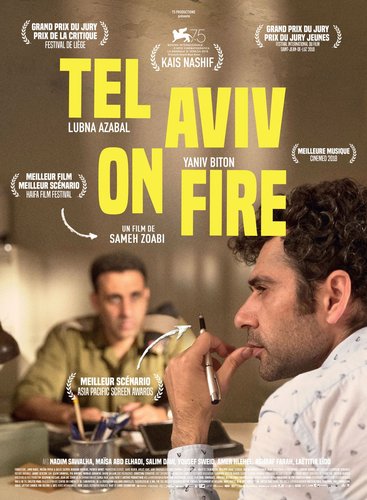
Tel Aviv on Fire (Hebrew: Tel Aviv Al Ha'Esh) is a 2018 satirical comedy-drama, set in the shadow of the Israeli occupation of the West Bank, that makes playful fun of a soap opera and the people around it. Sameh Zoabi directed it and wrote it with Dan Kleinman. An Israeli, Luxembourgish and French co-production, it was shot in Arabic and Hebrew, and is Zoabi's second feature after Man Without a Cell Phone. The story is said to draw on a Mexican soap opera. Artémis Productions is the production company.

The film shows the occupation without commenting on it at length; the people around the soap opera are caught between private dreams, everyday pragmatism and exhaustion. Kais Nashef plays Salam, Lubna Azabal plays Tala, Maisa Abd Elhadi plays Mariam and Salim Daw plays Atef, while Nadim Sawalha, Yousef Sweid and Amer Hlehel are also in the cast.

The film premiered internationally in the Orizzonti section of the 75th Venice Film Festival, where Kais Nashef won the Best Actor award. Its Israeli premiere came at the Haifa International Film Festival, where it won Best Film and Best Screenplay. Luxembourg selected it as its entry for Best International Feature Film at the 92nd Academy Awards, but it did not receive a nomination.

DirectorSameh Zoabi
Production companyArtémis Productions

Reactions

You can pick up to 3 reactions.

Cast

Names without a link have no profile here yet.

Lubna Azabal Lubna Azabal Actor · 53 years old Tala Kais Nashef Nadim Sawalha Maisa Abd Elhadi Yousef Sweid Amer Hlehel

Also in the cast: Salim Daw (Atef)

Through different eyes

AI-assisted editorial takes written from different viewer perspectives. They are not reader reviews; those are below.

Cinephile Looks at script, editing and directing choices; keeps a distance from formula films.

The clever idea behind Tel Aviv on Fire is to approach a heavy political reality through a soap opera. Rather than commenting on the occupation at length, Zoabi leaves it in the background as it is and aims his mocking energy at the clichés of the soap, so the film can work both as parody and as character comedy. Kais Nashef's Best Actor award in Venice's Orizzonti section suggests that this delicate balance rests largely on the lead's shoulders, and the Best Screenplay prize in Haifa points to the strength of the writing. My reservation: a soap-opera parody runs the risk of leaning on its own formula after a while, and the satire's edge can soften into safer comedy.

History & Society Lens Asks about the period, the social background and what the work reflects.

What makes the film socially interesting is that it shows people living under the shadow of the West Bank occupation without casting them as heroes or victims, but as ordinary people squeezed between private dreams, everyday pragmatism and exhaustion. The mix of Arabic and Hebrew within one film also conveys the everyday points of contact between two communities. The choice of a soap opera is no accident: the genre is a shared emotional language for huge audiences. Handling the conflict through humor rather than heavy political rhetoric may strike some viewers as too light; that distance is the film's most honest choice.

Family Viewer Asks whether the whole household can watch it; cares about humor and heart.

It's a comedy, but a heavy political reality, the occupation, sits in the background, and young children will struggle to see what the humor is touching on. Since it's spoken in Arabic and Hebrew, following subtitles may also be hard for kids. It's a good pick, though, for parents who like soap operas and for high-school teenagers curious about the world; it can open up a good conversation afterwards.

Reviews (0)

Log in Log in to write a review.

Comments