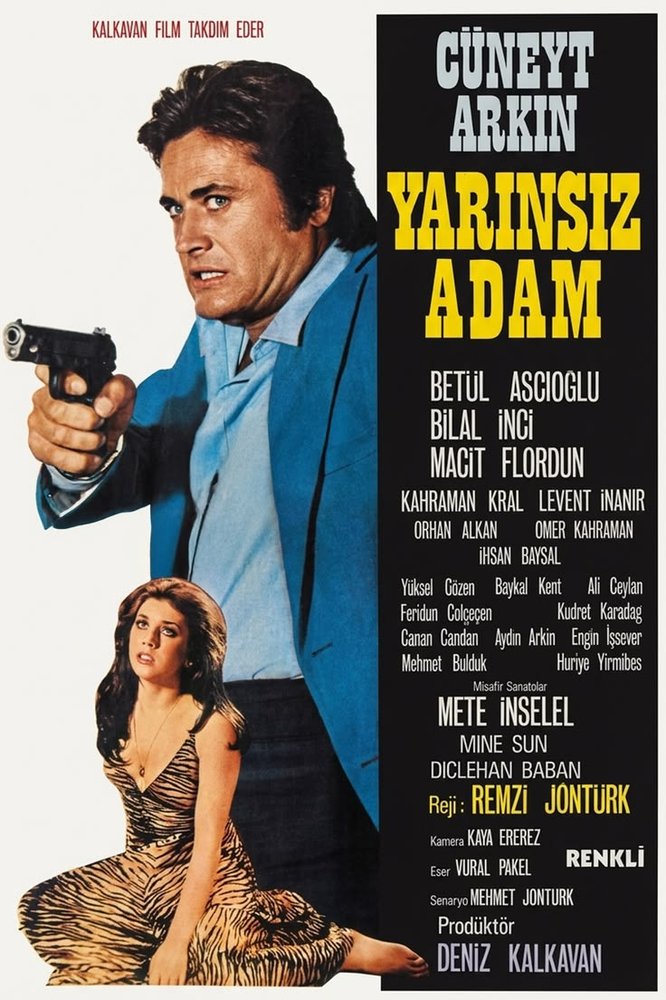
Yarınsız Adam

The Man Without a Tomorrow (Yarınsız Adam) (translated)

Movie · 1976 · 3 people

In 1976 Remzi Jöntürk made the political drama Yarınsız Adam ("The Man Without a Tomorrow"), the first part of his trilogy, which Satılmış Adam and Yıkılmayan Adam, both from 1977, complete. It blends political, adventure and drama elements and runs about 84 minutes. İhsan Yurdakul is credited as co-director alongside Jöntürk; the screenplay is by Mehmet Aydın, and Deniz Kalkavan produced for Kalkavan Film.

The story centres on Murat Demir (Cüneyt Arkın), who grew up in poverty and lives on the street. He shares the streets with his friend Kemal and Zeliş (Betül Aşçıoğlu), the girl he loves. Hunger pushes the two men to theft; Murat helps his friend flee the police and lands in prison, where a further offence lengthens his term. On release he takes up illegal work to help the street children who share his fate. Levent İnanır plays the young Murat and Bilal İnci is the Father.

Told through the eyes of a man pushed into crime by poverty, the film points to the gap between rich and poor in Turkey. As in Jöntürk's other political films the socialist message is sometimes blunt: a poor boy who gets into Murat's car says rich and poor cannot be friends, because the wealthy cannot understand the poor.

DirectorRemzi Jöntürk
Production companyKalkavan Film

Reactions

You can pick up to 3 reactions.

Cast

Through different eyes

Yeşilçam Nostalgic A viewer raised on the classics, looking for warm storytelling and strong acting.

This first instalment of Remzi Jöntürk's trilogy is one of the films that put Cüneyt Arkın's conscience ahead of his heroics. A man raised in poverty who, once out of prison, takes care of the street children who share his fate: that carries the familiar yet still touching moral centre of Yeşilçam. His love for Zeliş brings a little warmth into the film's hard world. It must be said, though, that the message is at times delivered so openly that it feels more like a lectern than a story told with finesse.

History & Society Lens Asks about the period, the social background and what the work reflects.

Made in 1976, the film looks at the gulf between rich and poor in Turkey through the eyes of a man pushed into crime, which makes it a typical example of the political cinema of its day. Hunger leads to theft, theft to prison, prison to illegal work, and that chain invites us to read crime as a social outcome rather than a personal failing. The place of the street children matters here too: they are a reminder that poverty passes from one generation to the next. For anyone who wants to understand how the sharp social divisions of the 1970s found their way onto the screen, it has real documentary value.

Cinephile Looks at script, editing and directing choices; keeps a distance from formula films.

A problem common to Jöntürk's political films shows up here as well: the thesis overrides the dramaturgy. The characters often stand for positions rather than people, and because the contrast between rich and poor is spelled out in dialogue, meaning that could have been left to images and editing goes to waste. On the other hand, 84 minutes is surprisingly economical for a narrative trying to hold politics, adventure and drama under one roof. The overall effect is less that of a standalone film than of the opening chapter of a trilogy; seen alongside Satılmış Adam and Yıkılmayan Adam, it becomes a more meaningful whole.

These are not reader reviews: they are short editorial takes written from different viewer perspectives with AI assistance. Reader reviews are below.

Reviews (0)

Log in Log in to write a review.

Comments