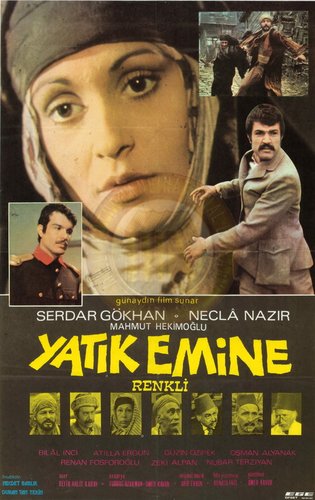
Lying Emine (Yatık Emine)

Lying Emine (Yatık Emine) (translated)

Movie · 1974 · 9 people

Ömer Kavur directed Yatık Emine, a 1974 Turkish drama and his first feature film. It opened in theaters on September 1, 1974. It is an adaptation of the story of the same name in Refik Halit Karay's Memleket Hikâyeleri (1919).

The film tells the story of a woman named Emine who is exiled to a small Anatolian town. Necla Nazır plays Emine and Serdar Gökhan plays the male nurse Server. Many townspeople and local figures appear in the story: Bilâl İnci plays the petition writer Deli İsmail, Mahmut Hekimoğlu the commander, Nubar Terziyan Dimitri, Renan Fosforoğlu the district governor, and Osman Alyanak the baker Mustafa. The cast also includes Güzin Özipek (Tahir's wife), Zeki Alpan (Uncle Tahir), Atilla Ergün (Rıza), Ahmet Turgutlu (the sergeant) and Müşerref Çapın (a female prisoner). The film is dubbed: Tijen Par voices Necla Nazır, Pekcan Koşar voices Serdar Gökhan, and Şener Şen voices Osman Çağlar.

The screenplay was written by Ömer Kavur and Turgut Özakman together, and the producers were Necdet Barlık and Duran Tantekin. The music is by Arif Erkin and the cinematography by Renato Fair. Günaydın Film is credited with production and Barlık Film with operations.

DirectorÖmer Kavur
Production companyGünaydın Film

Reactions

You can pick up to 3 reactions.

Cast

Also in the cast: Güzin Özipek, Zeki Alpan, Ahmet Turgutlu, Müşerref Çapın, Renan Fosforoğlu (District governor), Osman Çağlar (İsmail)

Through different eyes

AI-assisted editorial takes written from different viewer perspectives. They are not reader reviews; those are below.

Cinephile Looks at script, editing and directing choices; keeps a distance from formula films.

Adapting a story by an established author for his first feature was an ambitious start for Ömer Kavur. Turning a short literary text by Refik Halit Karay into a screenplay with Turgut Özakman means filling with images what the page leaves unsaid, and the film fills that space with a wide gallery of townspeople. Characters ranging from the petition writer to the district governor, from the baker to the commander, bring the setting to life, but they also risk pushing Emine's own story into the background at times. The relationship between an outcast woman and a community watching her is material that makes you question at every moment where to put the camera. Poised between a debut's daring and an adaptation's limits, it is a starting point that anyone curious about Kavur's cinema should not skip.

History & Society Lens Asks about the period, the social background and what the work reflects.

As its title suggests, Memleket Hikâyeleri is a book that looks at the provinces, and Yatık Emine reads that provincial world through one woman's exile. How a woman sent to the town from outside, and as an exile at that, is seen within a small community of district governor, commander, petition writer and tradesmen seems to be the film's real question. A character like Dimitri also recalls that the town's past was not of a single color. The tension between a lone woman and the judging gaze of the community makes visible the borders between state and town, outsider and local. Retelling a 1919 story in the seventies also shows how lasting these questions are.

Yeşilçam Nostalgic A viewer raised on the classics, looking for warm storytelling and strong acting.

Yatık Emine is a film in which the usual warmth is not easy to find. The story of an exiled woman in a small Anatolian town sits far from Yeşilçam's family melodramas built on tears and reunions. For a reader who grew up with Refik Halit's prose, seeing this story brought to the screen is valuable, and Arif Erkin's score offers fitting company to the heavy mood. Forming an emotional bond with the characters asks for more patience than the easy-to-love heroes of the old films did.

Reviews (0)

Log in Log in to write a review.

Comments