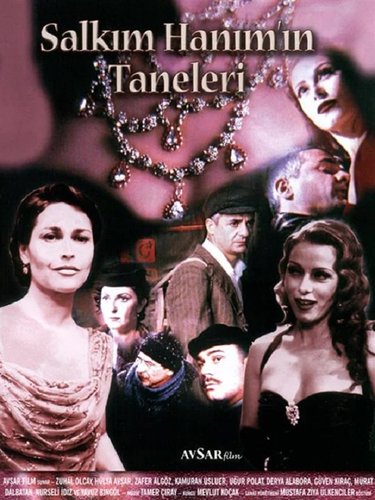
Mrs. Salkım's Diamonds (Salkım Hanımın Taneleri)

Mrs. Salkım's Diamonds (Salkım Hanımın Taneleri)

Movie · 1999 · 14 people

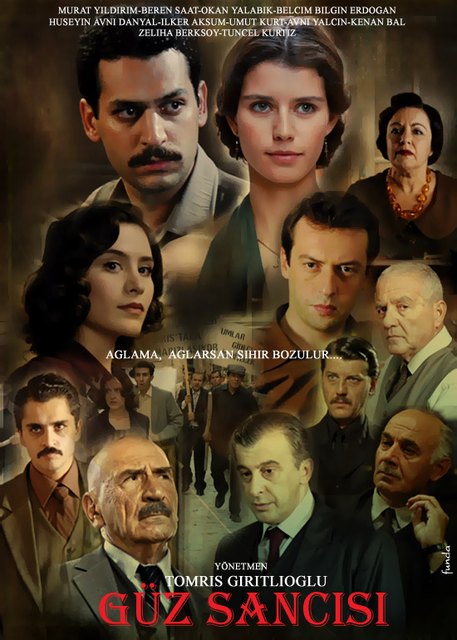
Drawn from Yılmaz Karakoyunlu's historical novel of the same name, Tomris Giritlioğlu's Salkım Hanım'ın Taneleri (Mrs. Salkım's Diamonds) mixes history and drama with noir; the Turkish film opened on November 19, 1999. It won awards at the Antalya and Istanbul festivals, among them the Golden Orange for Best Film. Turkey put it forward for the 72nd Academy Awards' foreign-language category, but it was not accepted as a nominee. It is regarded as a companion to the 2008 film Güz Sancısı, by the same writer and director.

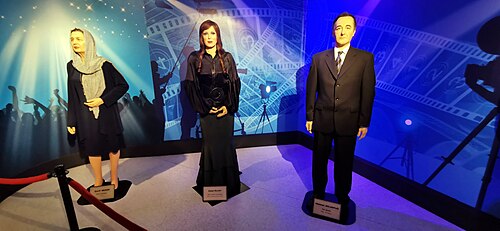
The story begins in the 1940s, shortly before a heavy levy is imposed on non-Muslims. Durmuş (Zafer Algöz) and his wife Nimet (Derya Alabora) move from Niğde to Istanbul. Durmuş finds work through his townsman Bekir (Güven Kıraç) but, ambitious and money-hungry, wants more. Bekir works for the wealthy Halit Bey (Kamran Usluer), whose wife Nora (Hülya Avşar) has lost her sanity and lives on the mansion's top floor, while Halit Bey has begun an affair with Nefise (Zuhal Olcay). Durmuş's arrival, the Wealth Tax and the exiles to Aşkale that follow affect everyone.

Tamer Baran and Etyen Mahçupyan wrote the screenplay; Avşar Film produced, with Tamer Çıray as composer. It runs about 135 minutes.

DirectorTomris Giritlioğlu
Production companyAvşar Film

Reactions

You can pick up to 3 reactions.

Cast

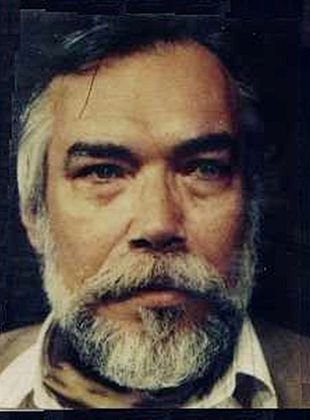
Also in the cast: Yılmaz Karakoyunlu
Through different eyes

History & Society Lens Asks about the period, the social background and what the work reflects.

Adapted from Yılmaz Karakoyunlu's novel, the film is a significant work that brought to mainstream cinema the Capital Tax, which imposed a heavy burden on non-Muslims in the 1940s, and the Aşkale deportations that followed. The story of ambitious Durmuş, who comes from Niğde to make his way in Istanbul, shows along lines of class and migration how this order meant loss for some and opportunity for others. The relationships in Halit Bey's mansion reveal how the social rupture seeped into everyday life. Shedding light on a rarely discussed period, together with its success at the Golden Orange, makes it a point of reference. Still, in places the melodrama arguably outweighs the historical gravity.

Cinephile Looks at script, editing and directing choices; keeps a distance from formula films.

Tomris Giritlioğlu builds an ambitious structure by combining history, drama and film noir elements. Durmuş's ambition and the decay in Halit Bey's mansion run in parallel, as the script tries to gather a large cast of characters around a historical rupture. Zafer Algöz's Durmuş is among the strongest performances in the film, unsettling and convincing. The characters played by Zuhal Olcay and Hülya Avşar, by contrast, find less depth on the page. Across roughly 135 minutes some subplots remain scattered, and the editing cannot always sustain the pace. Its Golden Orange for Best Film is a sign that it met its bold subject with a strong cinematic language.

Family Viewer Asks whether the whole household can watch it; cares about humor and heart.

A film with a heavy and important subject. It tells of painful events such as the Capital Tax and the deportations, which makes it a good chance to talk about history as a family. But it is not suitable for young children; the themes are dark and some of the relationships are for adults. You can watch it with high-school-age kids. It is long, over two hours, so plan for that.

These are not reader reviews: they are short editorial takes written from different viewer perspectives with AI assistance. Reader reviews are below.

Reviews (0)

Log in Log in to write a review.

Comments