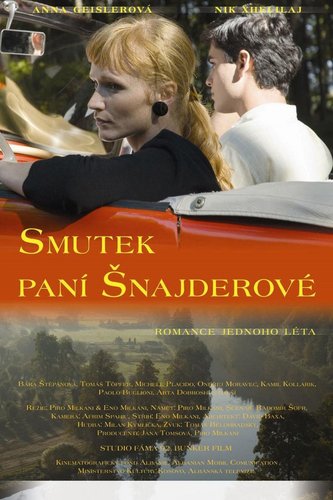
The Sorrow of Mrs. Schneider (Trishtimi i zonjës Shnajder)

The Sorrow of Mrs. Schneider (Trishtimi i zonjës Shnajder)

Movie · 2008 · 15 people

Piro Milkani co-directed this 2008 romantic drama with his son Eno, and wrote its script with Radek Šofr. An Albanian-Czech production, The Sorrow of Mrs. Schneider carries the titles Trishtimi i zonjës Shnajder in Albanian and Smutek paní Šnajderové in Czech. Shot in Czech, it is a co-production of Albania, the Czech Republic and Greece, runs about 104 minutes and is credited to the Albfilm studio. In German it is Die Trauer der Frau Schneider and in French Le Chagrin de Mme Schneider.

The story is inspired by Piro Milkani's student years in Czechoslovakia and tells the romance of an Albanian film student in Prague. It is set in 1961. While shooting his graduation film at a small-town motorcycle factory, the student is drawn to the free way of life of Czech youth and falls in love with a police chief's wife. Nik Xhelilaj plays the lead, and the cast includes Anna Geislerová, Michele Placido, Tomáš Töpfer, Arta Dobroshi, Violeta Manushi, Barbora Štěpánová and Pavel Bobek.

Filming took place in the Czech Republic, and the film was first shown on March 14, 2008. Albania submitted it for the 81st Academy Awards in the foreign-language category, but it did not make the final list.

DirectorPiro Milkani, Eno Milkani

Reactions

You can pick up to 3 reactions.

Cast

Names without a link have no profile here yet.

Nik Xhelilaj Nik Xhelilaj Actor · 43 years old Lekë Seriani Anna Geislerová Michele Placido Arta Dobroshi Violeta Manushi Barbora Štěpánová Tomáš Töpfer Pavel Bobek Hana Baroňová Kamil Kollárik Bohumír Starý Jakub Jech Petra Novotná Paolo Buglioni Veronika Novotná

Through different eyes

Cinephile Looks at script, editing and directing choices; keeps a distance from formula films.

A film about a student shooting his graduation film, drawn from the director's own student years, sets up a neat mirror effect: the camera sits both inside and outside the story. Piro Milkani sharing the credit with his son Eno gives this personal material the chance of a two-generation view. Still, memory cinema has a familiar trap, and it waits here too: affection for the past can soften the dramatic conflict and leave the risks of loving a married woman lighter than they should be. In my view it is best taken as a restrained, graceful period romance rather than a bold piece of work; Albania sending it to the Oscar race shows how much weight the country's cinema gave it.

History & Society Lens Asks about the period, the social background and what the work reflects.

Through the eyes of an Albanian film student in 1961 Prague, the film tries to make visible the gap between two societies of the same era. The free way of life of Czech youth is drawn from an outsider's angle, as something both attractive and boundary-pushing. That the woman he falls for is a police chief's wife signals from the outset that a private feeling will collide with the authority of the day. Young people studying abroad, caught between the rules of home and the freedom of their new surroundings, remain a familiar experience; a three-country co-production is a fitting frame for these crossing lives.

Family Viewer Asks whether the whole household can watch it; cares about humor and heart.

Its subject is love for a married woman, so this is not a family film to watch with young children. It suits adults and older teens who enjoy period stories. It was shot in Czech, so most households will need subtitles, which is another hurdle for little ones. For an evening with the whole family together, something lighter is the better pick.

These are not reader reviews: they are short editorial takes written from different viewer perspectives with AI assistance. Reader reviews are below.

Reviews (0)

Log in Log in to write a review.

Comments