On Board (Gemide)

On Board (Gemide)

Movie · 1998 · 7 people

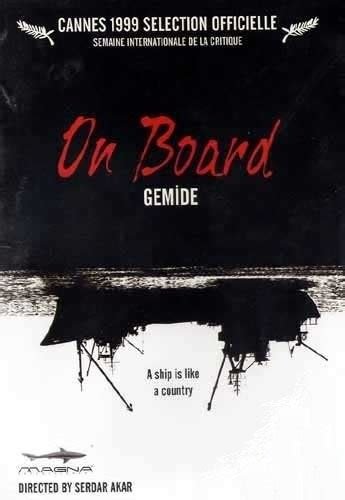
Serdar Akar's Gemide (On Board), a Turkish film from 1998, mixes adventure, drama and thriller in a harsh story. Produced by Yeni Sinemacılık, it was released across Turkey on December 4, 1998. It runs 112 minutes. It won awards in Ankara and Antalya, including the Golden Orange for second-best film. Many critics regard it as a cult film, ranking it among the best Turkish films of the 1990s.

The story follows the crew and captain of a sand barge. The enclosed world of the ship is broken by violence once the men go ashore: the sailors carry a woman off to the vessel, and the act drags everyone into a spiral with no way back. The film uses this story to hold up a critical mirror to the warped structure of Turkish society. Erkan Can plays Captain İdris, with Haldun Boysan as Kamil, Yıldıray Şahinler as Ali, Güven Kıraç as Aziz and Cengiz Küçükayvaz as the Doctor.

Akar wrote the screenplay with Önder Çakar, and Sevil Demirci and Çakar produced. Mehmet Aksın was cinematographer and Uğur Yücel composed the music. Gemide was shot at the same time as Kudret Sabancı's Laleli'de Bir Azize (A Madonna in Laleli), and the main characters of the two films cross paths.

DirectorSerdar Akar
Production companyYeni Sinemacılık

Reactions

You can pick up to 3 reactions.

Cast

Also in the cast: Ella Manea, İştar Gökseven

Through different eyes

Cinephile Looks at script, editing and directing choices; keeps a distance from formula films.

Gemide is a harsh film that carved out its own place in 1990s Turkish cinema, and it's easy to see why it is considered a cult work. Serdar Akar builds the enclosed world of a sand barge almost like a pressure chamber; as the violence brought aboard from the shore echoes inside, the way out narrows. Erkan Can's Captain İdris, alongside Haldun Boysan, Güven Kıraç and Yıldıray Şahinler, forms a strong acting core that carries the film's texture. Mehmet Aksın's cinematography and Uğur Yücel's score reinforce the stifling atmosphere. Shooting it alongside A Madonna in Laleli, with characters crossing between the two films, was a bold narrative experiment for its time. Yet the film doesn't always keep its balance on the thin line between condemning violence and putting it on display, and that harshness may test some viewers' limits.

History & Society Lens Asks about the period, the social background and what the work reflects.

Gemide is less about telling a crime story than about holding a critical mirror to a warped social structure. The all-male world of the sand barge, with its hierarchy and closed-off nature, works like a small model of society; when the men go ashore and carry a woman off to the ship by force, the way this order looks at women is laid bare. The film doesn't pin the violence on a single villain but shows it as a spiral that pulls everyone in. That stance represents the side of late-1990s Turkish cinema that avoided easy answers and asked uncomfortable questions. It isn't easy viewing, but it deserves discussion.

Family Viewer Asks whether the whole household can watch it; cares about humor and heart.

This film is not suitable for children at all. The story is about sailors carrying a woman off to their ship by force, and the violence that follows. It is heavy, dark and disturbing. If you want a film for a family evening, pick something else. Adults, especially those not used to harsh cinema, should know what they are getting into before pressing play.

These are not reader reviews: they are short editorial takes written from different viewer perspectives with AI assistance. Reader reviews are below.

Reviews (0)

Log in Log in to write a review.

Comments