The Second Wife (Kuma)

The Second Wife (Kuma) (translated)

Movie · 2012 · 5 people

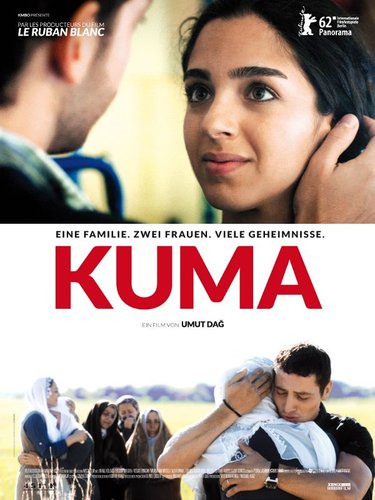
The young Austrian director Umut Dağ set his 2012 drama Kuma in the closed world of a Turkish immigrant family in Vienna. The title is the Turkish word for a second wife in a polygamous marriage, and the film is also known as The Second Wife. Produced by Wega Film, it has dialogue in both Turkish and German. It opened the Panorama section of the 2012 Berlin Film Festival.

The story begins when Fatma, a mother of five, is diagnosed with cancer. Wanting her family cared for according to tradition, she picks the young Ayşe from Anatolia herself and brings her to Vienna as a second wife for her husband Mustafa. Nihal Koldaş plays the ailing mother and Begüm Akkaya the second wife; Vedat Erincin is also in the cast. In a restrained style, the film follows two women in a house sealed off from the outside world, with clashing outlooks and impossible expectations.

Dağ, an Austrian-born filmmaker of Kurdish descent, made short films and documentaries before this first feature, and co-wrote the script with Petra Ladinigg. The film opened in Austria on April 27, 2012, and reached Turkish cinemas in April 2013 with only 10 prints. One Turkish critic tied that narrow release to the familiar fate of small festival films.

DirectorUmut Dağ
Production companyWega Film

Reactions

You can pick up to 3 reactions.
Cast

Through different eyes

History & Society Lens Asks about the period, the social background and what the work reflects.

The most striking thing about Kuma is that it does not tell its migration story from the usual angle. The family in Vienna keeps tradition alive in a house closed to the outside world, and the decision to bring in a second wife is made not by the man but by the ailing mother herself. That choice shows how a patriarchal order can be carried by women too, and it saves the film from easy blame. The dialogue moving between Turkish and German also reflects a family living between two cultures. A sharp observation for anyone interested in migration, family and women's lives.

Cinephile Looks at script, editing and directing choices; keeps a distance from formula films.

In his first feature Umut Dağ chooses not to fall into the melodrama trap. The subject could easily have become a shouting family drama, but the film moves in an unshowy register and builds its tension less from big scenes than from the expectations piling up inside a closed house. That restraint is its greatest strength and also its limit: the confined setting and calm rhythm sap the dramatic momentum in places. Still, opening the Berlin Panorama was no accident; this is a careful debut by a director finding his voice. Its narrow release in Turkey may have let it slip by, and it is worth seeking out.

Family Viewer Asks whether the whole household can watch it; cares about humor and heart.

Not one for children. It deals with heavy subjects such as cancer, polygamy and tension inside a family. Teenagers can watch it, but you will want to talk afterwards, because the second-wife question leaves them with things to ask. Not for a fun family night; better for adults looking for a drama that makes them think.

These are not reader reviews: they are short editorial takes written from different viewer perspectives with AI assistance. Reader reviews are below.

Reviews (0)

Log in Log in to write a review.

Comments