The Road (Yol)

The Road (Yol) (translated)

Movie · 1982 · 6 people

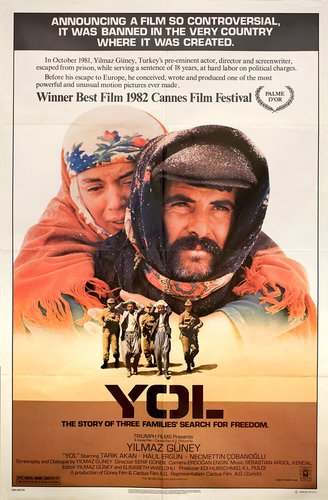
Turkey after the 1980 coup comes into view in Yol ("The Road"), a politically charged drama told through the stories of five prisoners. Yılmaz Güney wrote it while in prison, and his former assistant Şerif Gören shot it on his detailed instructions. At Cannes in 1982 it shared the Palme d'Or with Costa-Gavras's Missing, the first Turkish production to win it. Banned in Turkey for years, it reached cinemas there on February 12, 1999.

Five inmates of İmralı Open Prison get a week's leave and head home. Tarık Akan plays Seyit Ali, who must punish his wife Zine (Şerif Sezer) for dishonouring him; Halil Ergün plays Mehmet Salih and Necmettin Çobanoğlu plays Ömer. The world outside proves as harsh as the prison, with repression, custom, poverty and the Kurds' plight running through it. It is also remembered as the first Turkish-language film to speak the word Kurdistan and include some Kurdish dialogue.

Güney Film, Maran Film and Cactus Film produced it, with music by Zülfü Livaneli and photography by Erdoğan Engin. The negatives went to Switzerland, and after escaping prison Güney finished the edit in France. It was Switzerland's submission for the 55th Academy Awards but was not nominated. For 32 years, until 2014, it was Turkey's only Palme d'Or winner.

DirectorYılmaz Güney, Şerif Gören
Production companyGüney Film, Maran Film, Cactus Film
ScreenwriterYılmaz Güney
Film producerYılmaz Güney
Film editorYılmaz Güney
ComposerZülfü Livaneli
The Road (Yol)

Reactions

You can pick up to 3 reactions.

Cast

Through different eyes

AI-assisted editorial takes written from different viewer perspectives. They are not reader reviews; those are below.

Cinephile Looks at script, editing and directing choices; keeps a distance from formula films.

Yol is one of those rare films remembered as much for how it was made as for what is on screen: Yılmaz Güney wrote it in prison, Şerif Gören shot it on his detailed instructions, and the edit was finished in France. That direction by proxy shows at times; the cutting between the five stories is uneven in intensity, and some strands sit in the shadow of others. Still, Erdoğan Engin's photography makes the outside world feel as enclosing as a prison yard, and Zülfü Livaneli's score helps carry the weight. The thread shared by Tarık Akan and Şerif Sezer holds the film's most shattering performances. It is not hard to see why it shared the Palme d'Or.

History & Society Lens Asks about the period, the social background and what the work reflects.

Yol reads post-coup Turkey after 1980 through five prisoners' week of leave, and it states its sharpest idea early: outside the prison walls is no freer than inside. Repression, custom, poverty and the plight of the Kurds are spread across separate roads rather than crammed into one story. Its place as the first Turkish-language film to speak the word Kurdistan and include some Kurdish dialogue takes on added weight given that it stayed banned in Turkey for years, reaching cinemas there only in 1999. Seyit Ali's struggle with the duty of punishing his wife shows how the idea of honor crushes the individual more plainly than many sociology books. It can also be watched as a document of its time.

Family Viewer Asks whether the whole household can watch it; cares about humor and heart.

Custom, a woman who is to be punished over honor, poverty and repression: Yol's subject is very heavy. Don't expect light moments; the film hardly ever lets the weight go. It clearly matters, and it won the Palme d'Or. But it is best kept for adults watching together. If teenagers watch it, set aside time to talk afterwards.

Reviews (0)

Log in Log in to write a review.

Comments