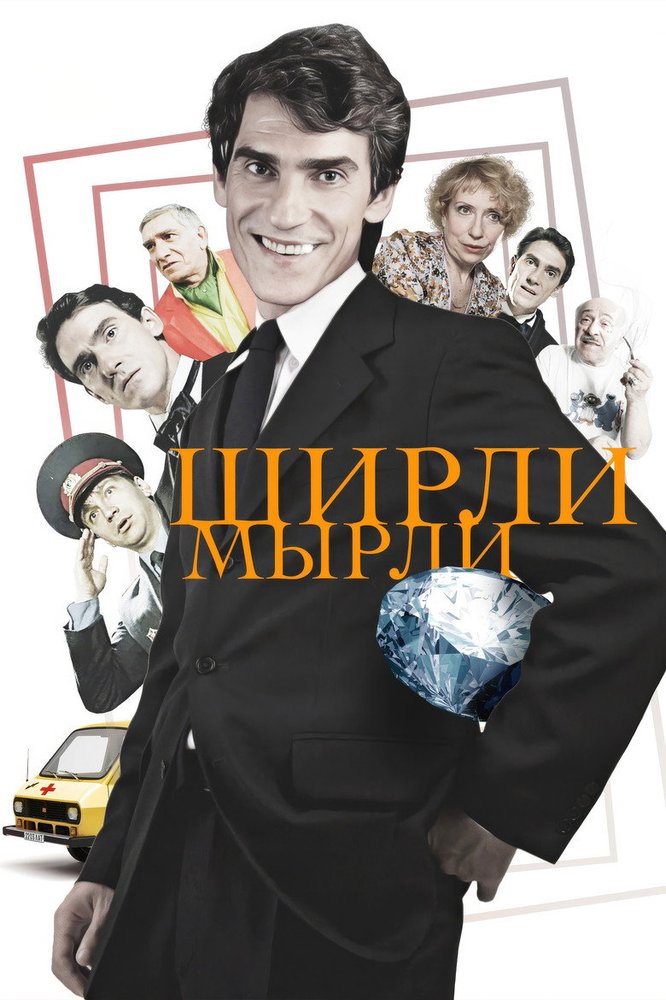
Shirli-Myrli

Shirli-Myrli

Movie · 1995 · 15 people

Vladimir Menshov directed Shirli-Myrli, a Russian farce made at Mosfilm in the early post-Soviet years and released in 1995 (Russian: Shirli-myrli; also known as What a Mess!). It runs about 136 minutes. It reached cinemas on 18 February 1995 and had its television premiere on RTR on 13 January 1996.

The plot grows out of a chain of chaotic events set off when a pursued con man steals a huge diamond. Valery Garkalin plays identical twins raised to believe they belong to different cultures and races, each looking down on the other; both Garkalin and Vera Alentova appear in four roles. Inna Churikova, Armen Dzhigarkhanyan, Igor Ugolnikov and Sergey Batalov also appear. The film satirises chauvinism, antisemitism and other ethnic tensions in 1990s Russia.

The screenplay is by Menshov, Vitaly Moskalenko and Andrey Samsonov, and it won the main prize in the entertainment-cinema category at the 1993 Nadezhda screenplay competition. In 1995 Garkalin took the best actor prize for the film at the Kinoshock festival in Anapa. It was Menshov's fourth film as director and his first since Love and Pigeons in 1984. The title comes from a simple tune sung by the main character, and a script book with a different ending appeared the same year.

DirectorVladimir Menşov
Production companyMosfilm

Reactions

You can pick up to 3 reactions.

Cast

Only cast members with a profile on this site are listed.

Armen Cigarhanyan Armen Cigarhanyan Stage actor · died at 85 Vsevolod Sanayev Vsevolod Sanayev Actor · died at 83 Valeri Garkalin Vera Alentova Inna Churikova Leonid Kuravlyov Lyubov Polishchuk Alexandr Pankratov-Chorny Nina Alisova İrina Apeksimova Lev Borisov Aleksey Buldakov Rolan Bıkov Yuri Chernov Marina Golub
Through different eyes

History & Society Lens Asks about the period, the social background and what the work reflects.

What sets Shirli-Myrli apart from an ordinary mix-up comedy is that it aims its laughter at a wound in 1990s Russia. The idea of identical twins raised to believe they belong to different cultures and races, each looking down on the other, sums up in one stroke how arbitrary the foundations of chauvinism and antisemitism are. Made amid the uncertainty of the first post-Soviet years, the film also works as a record of that period's arguments over identity. Some references may stay closed to viewers who don't know the Russia of the time, but its mockery of contempt built on identity still holds.

Cinephile Looks at script, editing and directing choices; keeps a distance from formula films.

Menshov's approach to farce is bold but uneven. Having Garkalin and Alentova each play four roles is a clever device that carries the confusion of identity into the form itself, and the best actor prize at Kinoshock looks like due reward for carrying that load. Yet at about 136 minutes the running time is too long for a farce. The longer the chain of events set off by the diamond theft runs, the more the twin-and-identity mix-up loses its power to surprise; tighter editing would have let the satire strike harder. The screenplay's prize in the entertainment-cinema category makes sense; what is missing is a rhythm that lives up to it.

These are not reader reviews: they are short editorial takes written from different viewer perspectives with AI assistance. Reader reviews are below.

Reviews (0)

Log in Log in to write a review.

Comments