The Sob (Hıçkırık)

The Sob (Hıçkırık)

Movie · 1953 · 16 people

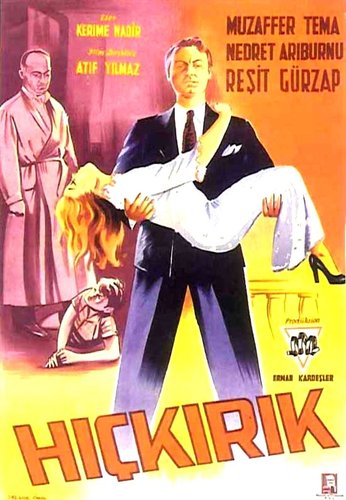
Atıf Yılmaz wrote and directed Hıçkırık (The Sob), a 1953 black-and-white Turkish drama film produced by Erman Film. It is the first screen adaptation of Kerime Nadir's 1938 novel of the same name, which was filmed again in 1965. Muzaffer Tema stars as Kenan opposite Nedret Güvenç as Nalan, with Reşit Gürzap, Settar Körmükçü, Muazzez Arçay and, as a schoolteacher, Nejat Saydam in supporting roles.

The story opens in Adapazarı, where young Kenan loses his mother and suffers under a harsh stepmother and stepfather. Through his teacher's intervention he is adopted by Muhip Azmi Bey of Istanbul and raised alongside the man's fragile, often ailing daughter Nalan. Over the years a deep but unspoken love grows between them, yet Nalan marries Dr. İlhami and has a daughter, Handan. After passing the foreign ministry exams, Kenan is posted to Rome, where a heartfelt letter he sends by mistake falls into İlhami's hands. Consumed by jealousy, İlhami takes the child away; the dying Nalan spends her final moments in Kenan's arms.

DirectorAtıf Yılmaz
Production companyErman Film

Reactions

You can pick up to 3 reactions.

Cast

Muzaffer Tema Muzaffer Tema Actor · died at 92 Kenan Nejat Saydam Film director · died at 71 Teacher Nedret Güvenç Nalan Temel Karamahmut Stepfather Leman Akçatepe Actor · 1918 – 1992 Perver Osman Altinay Muazzez Arçay Besime İhsan Aşkın Kutsi Baba Abdullah Ataç Fatma Bilgen Stepmother (Leyla) Karin Davutoglu child Belkıs Dilligil Belkıs Dilligil Actor · died at 66 Muazzez Doğan Consulate official Bilsev Etüs child Alev Koral Kenan's mother (as Alev Elmas) Reşit Gürzap Reşit Gürzap Actor · died at 78

Also in the cast: Settar Körmükçü
Through different eyes

Yeşilçam Nostalgic A viewer raised on the classics, looking for warm storytelling and strong acting.

Kerime Nadir's novel is a book of sorrow through and through, and Atıf Yılmaz's first adaptation meets that sorrow with the simplicity of black and white. What Kenan suffers under his stepparents, the love between him and Nalan that is never spoken, a letter that falls into the wrong hands: every vein of Yeşilçam's tearjerker tradition runs through it. Today's audiences may find so many tears excessive, and that is understandable. But the film is precious as a record of a cinema that knew how to speak straight to the heart, from an era unashamed of feeling.

Cinephile Looks at script, editing and directing choices; keeps a distance from formula films.

Written and directed by Atıf Yılmaz, this first adaptation of Hıçkırık plays more like a summary of the novel than a film in its own right. In trying to fit a crowded plot that runs from childhood in Adapazarı to Istanbul and on to Rome, the transitions between scenes feel hurried, and the characters' inner lives fall behind the density of events. The misdelivered letter, a classic melodrama device, works as a dramatic turning point but leans too heavily on coincidence. Still, the novel's second screen version in 1965 makes for an interesting study for anyone keen to compare the two; seeing how adaptation choices shifted over twelve years could be instructive.

History & Society Lens Asks about the period, the social background and what the work reflects.

Hıçkırık is a story built on adoption, stepfamilies and social climbing. A boy raised in hardship in Adapazarı joins a well-off Istanbul family through his teacher's intervention, which puts the role of education and well-meant patronage in social mobility to the fore. Kenan passing the foreign ministry exams and being posted to Rome recalls one of the ladders open to that generation: state service. To my mind the film's subtle point is that this rise brings no matching reward in his emotional life; the love that stays unspoken also hints at the weight of class and of one's place within a family.

These are not reader reviews: they are short editorial takes written from different viewer perspectives with AI assistance. Reader reviews are below.

Reviews (0)

Log in Log in to write a review.

Comments